DU Semester 1 Introductory Microeconomics: Complete Chapter-Wise Study Notes, Formula Sheet & PYQ Guide
The ultimate DU Semester 1 Introductory Microeconomics master guide: Unit-by-unit syllabus roadmap, full chapter links, comprehensive formula cheat sheet, PYQ patterns & 30-day revision strategy.
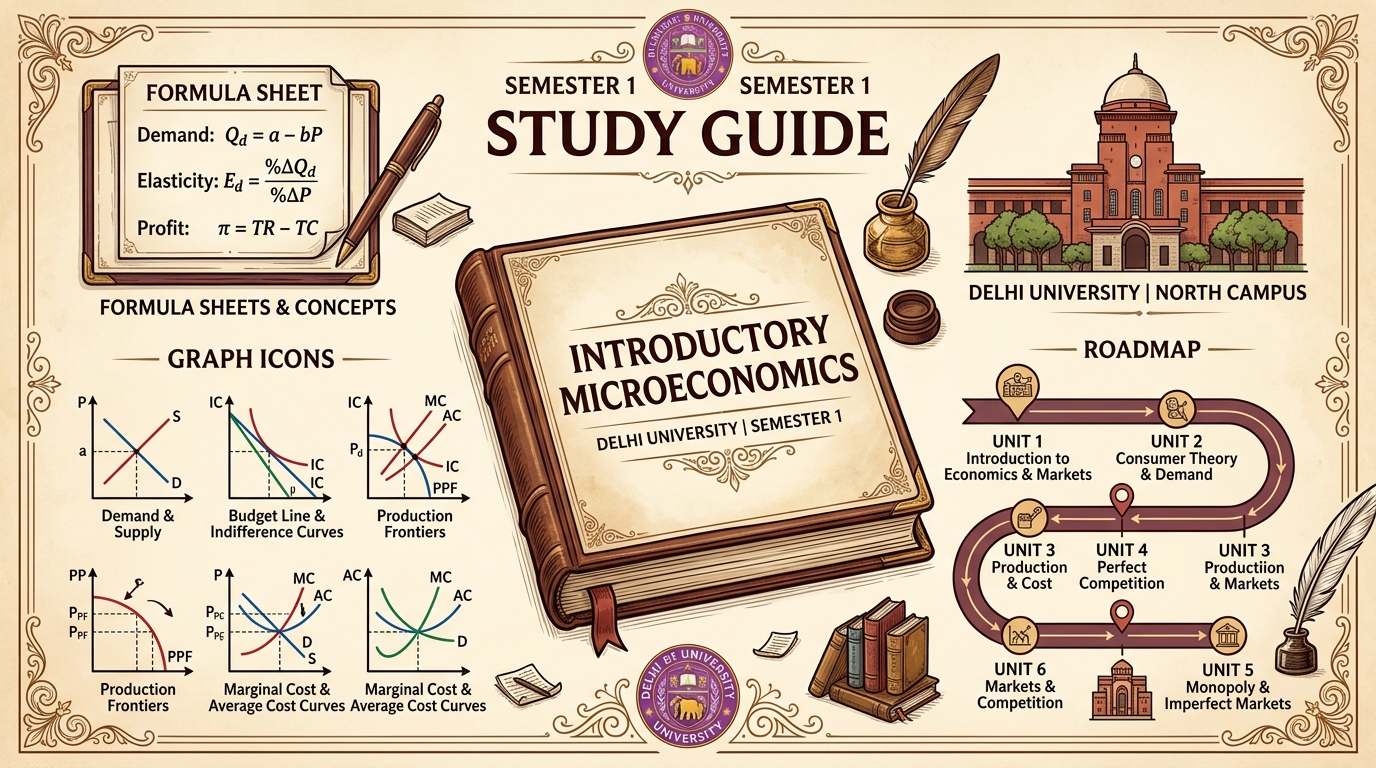
Introductory Microeconomics is the foundation stone of your Delhi University Economics (Honours) journey. It is the paper where you transition from memorising definitions in high school to proving theorems, building mathematical intuition, and optimising constrained functions in a rigorous university setting. This master pillar guide is the only resource you need to navigate the entire syllabus, structure your revision, and crack the final semester examinations with distinction.
1. Course Architecture & UGCF 2022 Curriculum Breakdown
Under the National Education Policy (NEP) 2020 and the Undergraduate Curriculum Framework (UGCF) 2022, Delhi University has fundamentally restructured the Economics Honours program. Introductory Microeconomics is a 4-credit Core Discipline Subject (DSC). The assessment is split into two major components: Internal Assessment (IA) and the End-Semester Examination.
- Total Credits: 4 Credits (3 Lecture hours + 1 Tutorial hour per week).
- Total Marks: 160 Marks (scaled/recorded as per college internal systems, usually 90 Marks Theory + 70 Marks IA/CA).
- End-Semester Theory Exam: 90 Marks. This is a 3-hour written examination where you must demonstrate your grasp of graphical analysis, mathematical derivations, and theoretical explanations.
- Continuous Assessment (CA) & Internal Assessment (IA): 70 Marks. This comprises class tests, mid-semester exams, assignments, presentations, and attendance.
Grading Guidelines: To score an O (Outstanding, 10 grade points) or an A+ (Excellent, 9 grade points), you cannot rely merely on regurgitating textbook theory. You need absolute precision in your diagrams, correct sign conventions in your mathematical derivations, and a structured approach to solving multi-part numericals. The jump from school-level economics to DU-level economics is steep, but mastering the rules of the game early guarantees a strong CGPA foundation.
2. Complete Unit-by-Unit Interactive Index & Navigation HUB
The syllabus is vast, but we have broken it down into 9 distinct, highly detailed study guides. Below is your complete index. Click on any link to jump directly to the comprehensive chapter notes, numerical breakdowns, and specific PYQ analyses for that exact unit.
Unit 1: Exploring the Subject Matter of Economics & PPF
This unit sets the philosophical and methodological stage. It asks the fundamental questions: what is economics, how do we model scarcity, and what are the trade-offs we face? You will encounter the Production Possibility Frontier (PPF), opportunity cost, and the mathematical representation of economic trade-offs. The exam rarely asks for definitions here; instead, expect to mathematically derive the slope of the PPF (Marginal Rate of Transformation) or analyze how technological shocks shift the frontier.
Core Concept: Opportunity Cost and the curvature of the PPF (increasing opportunity cost).
Direct Link: Read the Unit 1 Complete Guide
Unit 2: Demand, Supply, Elasticity & Market Equilibrium
Moving beyond basic intersecting lines, this unit rigorously defines the Walrasian and Marshallian stability of market equilibrium. You will cover the deep mechanics of price, income, and cross-price elasticities using point elasticity formulas and calculus. We also examine government interventions: price ceilings, price floors, taxes, subsidies, and the resulting deadweight loss. The incidence of tax (who actually pays it) is a guaranteed numerical problem in the finals.
Core Equations: Point elasticity E = (dQ/dP) * (P/Q). Tax incidence burden shared relative to elasticities.
Direct Link: Read the Unit 2 Complete Guide
Unit 3: Consumer Theory, Indifference Curves & Slutsky Equation
This is arguably the most mathematically intense unit of the semester. You will dive into utility functions (Cobb-Douglas, Perfect Substitutes, Perfect Complements, Quasilinear), budget constraints, and constrained optimization using the Lagrangian method. The climax of this unit is the Slutsky Equation, which decomposes the price effect into the substitution effect and the income effect. Mastering Hicksian vs. Slutsky decomposition is non-negotiable for a 9+ SGPA.
Core Equations: MRS = MU_x / MU_y = P_x / P_y. Slutsky equation decomposition.
Direct Link: Read the Unit 3 Complete Guide
Unit 4: Production Functions, Cost Curves & Returns to Scale
We flip to the producer side of the market. You will study Isoquants, Isocosts, and the Marginal Rate of Technical Substitution (MRTS). Returns to scale (constant, increasing, decreasing) are analyzed mathematically. We then translate the production function into short-run and long-run cost curves, proving relationships like MC intersecting ATC at its minimum, and understanding the envelope theorem as it applies to the Long-Run Average Cost (LRAC) curve.
Core Equations: MRTS = MP_L / MP_K = w / r. Cost minimization condition.
Direct Link: Read the Unit 4 Complete Guide
Unit 5: Perfect Competition: Short-Run & Long-Run Equilibrium
Perfect competition acts as the benchmark market structure. You will analyze profit maximization where Price = Marginal Cost (P = MC). This unit requires a firm grip on graphical analysis, tracing the short-run supply curve of the firm (the MC curve above AVC), analyzing short-run economic profits/losses, and understanding the long-run adjustment process where free entry/exit drives economic profits to zero.
Core Concept: P = MR = MC. Shutdown point is where P falls below min(AVC).
Direct Link: Read the Unit 5 Complete Guide
Unit 6: Monopoly, Price Discrimination & Deadweight Loss
Monopoly analysis introduces market power. The firm faces a downward-sloping demand curve, meaning Marginal Revenue (MR) is less than Price. You will derive the profit-maximizing output (MR = MC) and calculate the welfare loss (Deadweight Loss) compared to perfect competition. The unit deeply explores First, Second, and Third-Degree Price Discrimination, often tested through heavy numericals requiring you to set MR1 = MR2 = MC across two separate markets.
Core Equations: MR = P(1 + 1/E). Lerner Index = (P - MC) / P.
Direct Link: Read the Unit 6 Complete Guide
Unit 7: Monopolistic Competition, Oligopoly & Game Theory
Bridging the gap between perfect competition and monopoly, this unit introduces Monopolistic Competition (Chamberlin's model, excess capacity theorem) and Oligopoly. Game theory is applied to oligopolistic behavior, covering Nash Equilibrium, Prisoner's Dilemma, and dominant strategies. You must mathematically solve the Cournot Model (simultaneous quantity setting), Stackelberg Model (sequential quantity setting), and Bertrand Model (price setting).
Core Concept: Reaction functions in Cournot. Excess capacity in Monopolistic Competition.
Direct Link: Read the Unit 7 Complete Guide
Unit 8: Factor Market Pricing, Labor Supply & Economic Rent
How are wages and rents determined? This unit shifts focus to the input markets. You will learn how the demand for labor is a derived demand based on the Value of Marginal Product (VMPL) or Marginal Revenue Product (MRPL). The backward-bending supply curve of labor (analyzing income vs. substitution effects of a wage change) is a classic examination favorite, along with the concept of economic rent versus transfer earnings.
Core Equations: VMP_L = P * MP_L = w (in perfect competition).
Direct Link: Read the Unit 8 Complete Guide
Unit 9: Market Failure, Externalities & Public Goods
The final unit questions the efficiency of markets. What happens when there are externalities (pollution, education) or public goods (non-rival, non-excludable)? You will analyze Pigouvian taxes and subsidies, the Coase Theorem for internalizing externalities, and the Samuelson condition for the optimal provision of public goods (vertical summation of demand curves).
Core Concept: Social Marginal Cost (SMC) vs Private Marginal Cost (PMC). Samuelson Rule: Sum(MRS) = MRT.
Direct Link: Read the Unit 9 Complete Guide
3. Master Formula & Mathematical Theorem Cheat Sheet
Examiners do not just want the final answer; they want you to show the mathematical plumbing. Here is the master cheat sheet connecting the formulas across all 9 units. Memorise these, understand their derivations, and explicitly state them in your exam solutions.
Consumer Theory (Unit 3)
| Concept | Formula / Equation | Notes |
|---|---|---|
| Marginal Rate of Substitution (MRS) | MRS = MU_x / MU_y | Slope of the Indifference Curve. Diminishing MRS implies convexity. |
| Consumer Equilibrium | MRS = P_x / P_y | Tangency condition between Indifference Curve and Budget Line. |
| Cobb-Douglas Utility | U(x,y) = (x^alpha) * (y^beta) | Demand for x: x = (alpha / (alpha+beta)) * (M / P_x) |
| Slutsky Equation | Total Effect = Substitution Effect + Income Effect | TE = x(p1, m) - x(p0, m) |
Production & Costs (Unit 4 & 5)
| Concept | Formula / Equation | Notes |
|---|---|---|
| Marginal Rate of Technical Substitution | MRTS = MP_L / MP_K | Slope of the Isoquant. |
| Producer Equilibrium | MRTS = w / r | Cost minimization condition. |
| Returns to Scale (Cobb-Douglas) | Q = A * (L^alpha) * (K^beta) | alpha + beta > 1 (IRS), = 1 (CRS), < 1 (DRS) |
| Marginal Cost (MC) | MC = dTC / dQ = dTVC / dQ | Intersect ATC and AVC at their minimums. |
Market Structures & Factor Markets (Unit 6, 7 & 8)
| Concept | Formula / Equation | Notes |
|---|---|---|
| Lerner Index of Monopoly Power | L = (P - MC) / P = -1 / E_d | Ranges from 0 to 1. Higher value means more monopoly power. |
| Third-Degree Price Discrimination | MR_1 = MR_2 = MC | Equate marginal revenues across segmented markets. |
| Cournot Reaction Function (Firm 1) | q1 = (a - c - b*q2) / 2b | Derived by maximizing Profit1 taking q2 as given. |
| Value of Marginal Product (VMPL) | VMP_L = P * MP_L | Firms hire until VMP_L = wage rate (in perfectly competitive labor market). |
4. DU Previous 7 Years Question Paper (PYQ) Pattern & Weightage Analysis
To score heavily, you need to understand the anatomy of a DU Microeconomics question paper. After analyzing the past 7 years of DU regular and open-book examinations, a clear pattern emerges regarding how the 90 marks are distributed.
- Unit 3 (Consumer Theory): ~20 Marks. This is the heavyweight champion of the syllabus. You are guaranteed one 10-15 mark question requiring you to derive demand functions from a Cobb-Douglas utility function, followed by a Slutsky decomposition numerical.
- Unit 6 & 7 (Monopoly & Oligopoly): ~15-20 Marks. A multi-part Cournot vs. Stackelberg vs. Collusion numerical is a staple. Third-degree price discrimination numericals (two distinct demand curves, finding P1 and P2) appear almost every alternate year.
- Unit 9 (Market Failure): ~12-15 Marks. A classic 10-mark question on Pigouvian taxes or public goods (calculating the socially optimal quantity by vertically summing demand curves).
- Unit 4 & 5 (Production & Perfect Competition): ~15 Marks. Expect a derivation of cost functions or a question proving the long-run equilibrium properties (P = min LRAC).
- Theory vs. Numerical Split: Typically, the paper is 60% numerical and mathematical derivations, and 40% graphical theory and explanations. You cannot pass this paper by writing essays; you must do the math.
5. The 30-Day Distinction Revision Plan for DU Sem 1 Micro
The final month before the exam is crucial. Do not read the textbook cover to cover; your focus must shift to problem-solving, graph drawing, and timed practice. Here is a battle-tested 30-day revision strategy.
Week 1: The Core Mathematical Foundations (Days 1-7)
Focus entirely on Consumer Theory (Unit 3) and Production/Costs (Unit 4). These are the foundational pillars. Practice Lagrangian optimization daily. Solve at least 15 numericals on finding the optimal bundle for Cobb-Douglas, Perfect Substitutes (corner solutions), and Quasilinear preferences. Draw the Slutsky decomposition graph for normal, inferior, and Giffen goods three times a day until you can do it with your eyes closed.
Week 2: Market Structures & Firm Behavior (Days 8-14)
Move to Perfect Competition (Unit 5), Monopoly (Unit 6), and Oligopoly (Unit 7). For Monopoly, master the deadweight loss calculation and price discrimination. For Oligopoly, create a step-by-step algorithmic approach to solving Cournot and Stackelberg games. Memorize the steps to derive reaction functions. Practice finding the Nash Equilibrium in payoff matrices.
Week 3: The Extremes - Fundamentals and Failures (Days 15-21)
Cover the lighter but crucial units. Unit 1 and 2 (PPF, Elasticities, Tax incidence) should take no more than three days. Use the remaining days for Factor Markets (Unit 8) and Market Failure (Unit 9). Focus heavily on the backward-bending labor supply curve and Pigouvian tax numericals. Ensure you understand the distinction between vertical summation (Public Goods) and horizontal summation (Private Goods).
Week 4: The PYQ Gauntlet and Exam Simulation (Days 22-30)
Stop reading new material. Your only job now is solving PYQs. Take the past 5 years of papers. Sit at your desk for exactly 3 hours, with no phone, no music, and solve the paper end-to-end. Mark yourself strictly. Where did you lose time? Did you forget to label an axis? Did you mess up a sign convention in the Cournot derivative? Identify these weak spots and do targeted reviews.
6. Prescribed Textbooks & Chapter Mapping
While class notes and this guide are essential, referring to the prescribed readings for specific complex proofs is highly recommended. The DU syllabus formally maps to the following gold-standard texts:
- N. Gregory Mankiw, Principles of Economics: Excellent for Units 1, 2, 5, 8, and 9. Mankiw's explanations of elasticity, tax incidence, and externalities are unmatched in clarity. Read the chapters on Supply/Demand, Public Goods, and Labor Markets here.
- Hal R. Varian, Intermediate Microeconomics: A Modern Approach: This is the bible for Unit 3 (Consumer Theory) and Units 6 & 7 (Monopoly & Oligopoly). Varian is mathematically rigorous. You must master the chapters on Preferences, Utility, Choice, Demand, Slutsky Equation, Monopoly, and Oligopoly.
- B. Douglas Bernheim and Michael D. Whinston, Microeconomics: A fantastic supplementary text, especially for production functions, cost curves (Unit 4), and game theory applications. It provides excellent solved examples that often mirror DU PYQs.
7. Top 10 Exam-Day Rules for Scoring 9+ SGPA in Sem 1 Microeconomics
Knowing the economics is only half the battle; knowing how to write an economics exam is the other half. Follow these 10 rules rigorously.
- Label Every Axis and Curve: An unlabeled graph is a wrong graph. Always label the X and Y axes (e.g., Quantity of X, Price of X). Label every curve (D, S, MR, MC). Label equilibrium points (E*). Examiners deduct marks ruthlessly for naked graphs.
- Start with the Math, Conclude with the Intuition: When solving a numerical, state the initial formula, show the step-by-step calculus/algebra, box the final answer, and then write a one-sentence economic interpretation of that answer. (e.g., "The firm produces 50 units, yielding a maximum profit of Rs 500.")
- Draw Large, Clean Diagrams: Do not squeeze a complex Slutsky decomposition into a corner of the page. Use at least half a page for major diagrams. Use a ruler for straight lines and a smooth hand for curves.
- State Your Assumptions: In theory questions, always begin by stating the assumptions of the model (e.g., "Assuming a two-good world with rational consumers, convex preferences, and a fixed budget...").
- Time Management is Critical: A 15-mark question should take you a maximum of 30 minutes. If you hit 32 minutes, wrap up your current thought and move on. You can always come back. Do not leave a 10-mark question unattempted just to perfect a 15-mark answer.
- Use Standard Notation: Stick to the notation used in Varian or Mankiw (P for price, Q for quantity, w for wage, r for rental rate). Inventing your own notation confuses the examiner.
- Highlight Shift vs. Movement: Be explicit about whether a curve is shifting (change in exogenous variable) or whether you are moving along the curve (change in endogenous price).
- Show the First Order and Second Order Conditions (FOC & SOC): In maximization/minimization numericals, finding the FOC (setting derivative to zero) gets you partial marks. You must show the SOC (second derivative test) to prove it is indeed a maximum or minimum to get full marks.
- Define Technical Terms: If you use terms like "Pareto Optimal", "Deadweight Loss", or "Nash Equilibrium" in a long answer, provide a quick one-sentence definition before applying it.
- Review the Last 10 Minutes: Reserve the last 10 minutes of the exam to purely review your paper. Check sign conventions in math problems. Check if you boxed your final answers. Check if all axes are labelled. These 10 minutes can easily save you 4-5 marks of silly mistakes.
The journey through DU Semester 1 Microeconomics is rigorous, but entirely manageable with structured study, deep conceptual clarity, and disciplined PYQ practice. Bookmark this Master Pillar Guide, utilize the detailed Unit-by-Unit links above, and execute the 30-day revision plan. Good luck with your preparation, and aim for that perfect 10 SGPA!
Frequently asked questions
What is the weightage of numericals in the DU Semester 1 Microeconomics exam?
Typically, the exam is roughly 60% numericals and mathematical derivations, and 40% graphical theory. Practicing derivations like Slutsky and Cournot is mandatory.
Which books should I refer to for Sem 1 Introductory Microeconomics?
Hal Varian for Consumer Theory and Market Structures, and Gregory Mankiw for fundamentals, elasticity, and externalities, as prescribed by the DU syllabus.
How many hours of study does the microeconomics paper require?
Consistent practice of 1-2 hours daily focusing on mathematical derivations and graphs is sufficient. The 30-day intensive revision plan in this guide outlines exactly what to study.
Dhairya sat the same DU papers he now writes about. Acadly is his attempt to say the useful things his own first-year self would have wanted to hear.
Keep reading

DU Internal Assessment (IA) Masterclass 2026: Cracking Tests, Presentations & Assignment Scoring
Comprehensive 4,000-word tactical guide on maximizing Internal Assessment (IA) marks in Delhi University under UGCF 2022. Covers 30-40% IA weightage breakdown, class test strategies, assignment formatting templates, presentation slide design, and attendance grace marks.

The DU Long-Answer Playbook: Structuring 15-Mark & 20-Mark Answers for Top Grades
How to structure 15-mark and 20-mark economics and social science answers for DU evaluators. Full word-for-word model answer scripts, diagrammatic blueprints, marking rubrics, and time-block strategies.

The ₹799 Kurti Scam That Broke Open a ₹30-Crore Fraud Network
A Ramjas College student lost ₹6,450 to an Instagram kurti ad. Her complaint led Delhi Police to seven arrests and a ₹30-crore cyber fraud network. How the scam worked, and how to protect yourself.