Introductory Microeconomics Unit 1: Scarcity, Opportunity Cost, PPF & 10 Principles Notes
Complete DU Semester 1 Unit 1 study notes covering scarcity, choice, opportunity cost, Production Possibility Frontier (PPF) derivations, MRT, Mankiw's 10 principles & solved numericals.
The first unit of Introductory Microeconomics in Delhi University lays the foundation for everything you will study in the next three or four years. It moves you away from the Class 12 style of memorising definitions and pushes you towards mathematical formulation, logical reasoning, and rigorous problem-solving. This guide is designed to cover the entire Unit 1 syllabus comprehensively, giving you the theoretical depth, real-world Indian examples, and the fully solved numericals you need to ace your mid-terms and finals.
1. The Economic Problem: Scarcity, Choice, and Allocation
Economics is fundamentally the study of how society manages its scarce resources. Scarcity means that society has limited resources and therefore cannot produce all the goods and services people wish to have. Just as a household cannot give every member everything they want, a society cannot give every individual the highest standard of living to which they might aspire.
Scarcity and Choice
Scarcity is the root of all economic problems. If resources were infinite, economics would not exist. Because resources (land, labour, capital, entrepreneurship) are limited, society must make choices. Choice implies trade-offs, and every time you make a choice, you forgo an alternative. This leads us to the three fundamental questions every economy must answer:
- What to produce and in what quantities? Should an economy focus on consumer goods (like clothing and food) or capital goods (like machinery and infrastructure)? For example, should the Indian government allocate funds to build more schools or produce more defense equipment?
- How to produce? Should production be labour-intensive or capital-intensive? In a country like India with a massive population, labour-intensive techniques are often preferred for employment generation, whereas in Western countries, capital-intensive techniques are the norm.
- For whom to produce? How is the national output distributed among the members of society? Will it be based on purchasing power (capitalist approach) or equality and need (socialist approach)?
2. Opportunity Cost & Marginal Decision Making
Opportunity Cost
Opportunity cost is one of the most critical concepts in economics. It is defined as the value of the next best alternative forgone when a choice is made. It is not just about money; it includes time, effort, and other resources.
If you decide to spend 3 hours studying for your Microeconomics exam, the opportunity cost is the utility you could have gained from the next best alternative—perhaps watching a movie or working a part-time job that pays ₹200 per hour.
Marginal Decision Making (MB vs MC)
Economists assume that rational people make decisions at the margin. "Marginal" means incremental or additional. When deciding whether to consume one more unit of a good or spend one more hour studying, a rational decision-maker compares the Marginal Benefit (MB) with the Marginal Cost (MC).
Rule of thumb: If MB > MC, do it. If MB < MC, do not do it. You stop exactly where MB = MC to maximize net benefits.
Sunk Costs
A sunk cost is a cost that has already been incurred and cannot be recovered. A core principle of marginal thinking is that sunk costs should be ignored when making decisions.
Indian Example: Imagine you buy a non-refundable movie ticket for ₹500. After watching 30 minutes, you realize the movie is terrible. Should you stay and watch the rest? A rational economist would say no. The ₹500 is a sunk cost. Your marginal decision is whether the benefit of watching the next 90 minutes is greater than the cost of your time. If watching the movie gives you less utility than taking a nap or reading a book, you should leave the theater.
3. The Production Possibility Frontier (PPF)
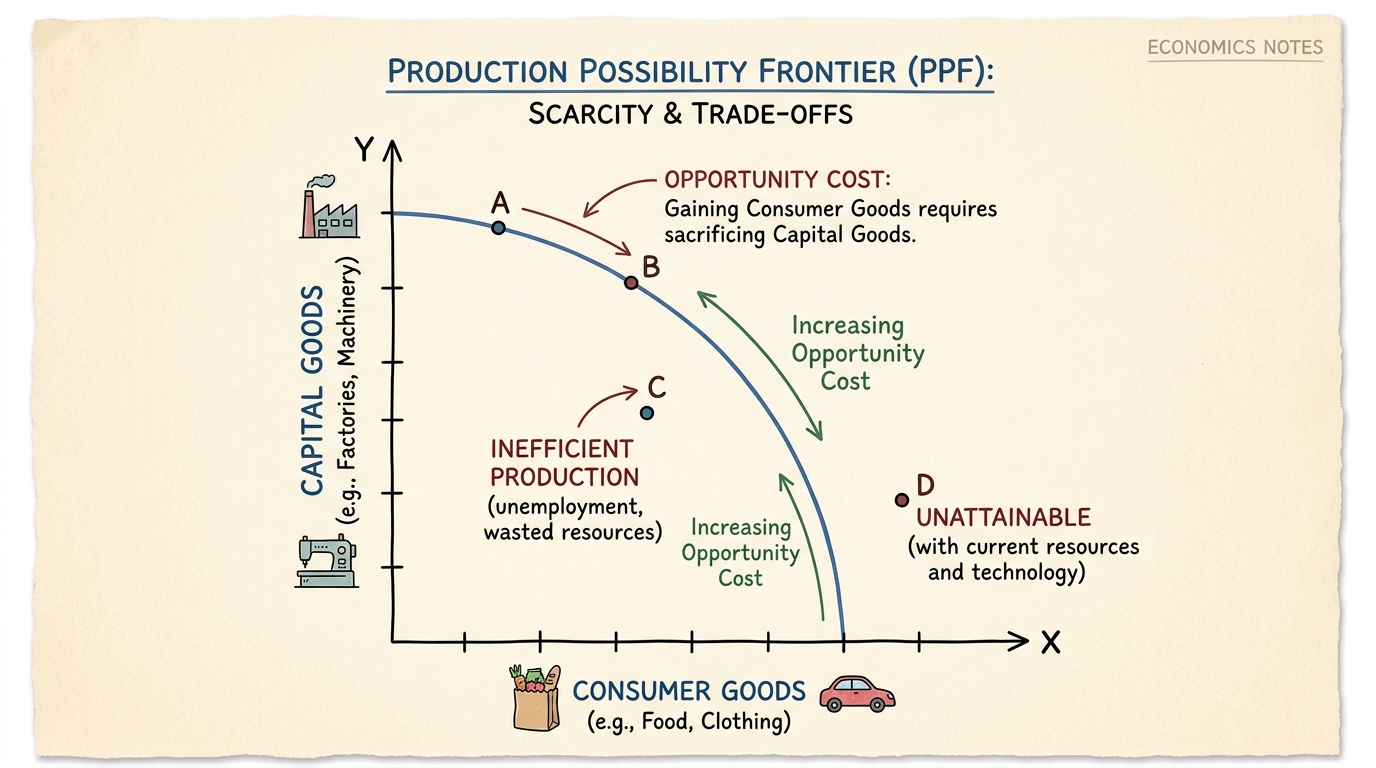
The Production Possibility Frontier (PPF) is a curve depicting all maximum output possibilities for two goods, given a set of inputs consisting of resources and other factors. The PPF assumes that all inputs are used efficiently.
Assumptions of the PPF Model
- Only two goods are produced in the economy (e.g., Guns and Butter, or Wheat and Cloth).
- Resources (land, labour, capital) are fixed in quantity but can be shifted between the production of the two goods.
- Technology is constant during the time period of the analysis.
- Resources are fully and efficiently utilized.
- Not all resources are equally efficient in producing both goods (this leads to increasing opportunity costs).
Mathematical Formulation & Marginal Rate of Transformation (MRT)
Let the two goods be X and Y. The curve can be represented as an equation, for example, X^2 + Y^2 = 100 or 2X^2 + Y = 100.
The slope of the PPF is the Marginal Rate of Transformation (MRT). It measures the rate at which one good must be sacrificed to produce an additional unit of the other good.
MRT = - dY / dX
Also, MRT is equal to the ratio of the marginal costs of producing the two goods: MRT = MCx / MCy.
Concavity Proof (Law of Increasing Opportunity Cost)
Why is the standard PPF concave to the origin? A curve is concave if its absolute slope increases as we move along the X-axis. Mathematically, the second derivative of the PPF equation (d^2Y / dX^2) must be negative.
The economic intuition behind concavity is the Law of Increasing Opportunity Cost. Since resources are not perfectly adaptable to the production of all goods, moving resources from the production of Y to X becomes increasingly costly. You first move the resources most suited for X. To produce even more X, you must start moving resources that are better suited for Y, thus sacrificing larger and larger amounts of Y for each additional unit of X.
Shifts vs Movements
- Movement along the PPF: Represents a change in the combination of goods produced, assuming fixed resources and technology. It reflects the trade-off.
- Shifts in the PPF: An outward shift of the entire curve indicates economic growth. This happens due to an increase in resources (e.g., population growth increasing the labour force, discovery of new natural resources) or an improvement in technology. If the technological improvement only affects one good, the PPF pivots outward along that axis.
4. Positive vs Normative Economics & Circular Flow
Positive vs Normative Economics
Positive Economics: Focuses on facts and cause-and-effect relationships. It deals with "what is." Positive statements can be tested and proven or disproven by data. Example: "An increase in the minimum wage causes an increase in unemployment among unskilled workers."
Normative Economics: Involves value judgments and opinions. It deals with "what ought to be." Normative statements cannot be tested. Example: "The government should increase the minimum wage to help the poor."
The Circular Flow Model
The circular flow diagram is a visual model of the economy that shows how dollars flow through markets among households and firms.
- Households: Own the factors of production (land, labour, capital) and consume all the goods and services that the firms produce.
- Firms: Produce goods and services using inputs from households, and sell outputs back to households.
- Markets for Goods and Services: Firms sell, households buy.
- Markets for Factors of Production: Households sell, firms buy.
The Role of Assumptions in Economic Models
Economists make assumptions to simplify the complex world and make it easier to understand. Just as a physicist assumes a vacuum to study falling objects, an economist might assume only two goods in the world to study trade-offs. The art in scientific thinking is deciding which assumptions to make.
5. Mankiw's 10 Principles of Microeconomics Explained (Indian Context)
Gregory Mankiw outlines 10 principles of economics that act as a framework for the entire subject. Let's look at them with Indian examples.
How People Make Decisions
1. People face trade-offs: "There ain't no such thing as a free lunch." To get something we like, we must give up something else. A student trading off study time for leisure. The Indian government trading off defense spending against healthcare spending.
2. The cost of something is what you give up to get it: This is opportunity cost. The cost of going to DU is not just the tuition fee, but the wages you give up by not working full-time.
3. Rational people think at the margin: Decisions are made by comparing marginal benefits and marginal costs. An Indian airline will sell a last-minute ticket for ₹2000 even if the average cost per seat is ₹4000, because the marginal cost of one extra passenger is just the cost of a small snack and a negligible amount of fuel.
4. People respond to incentives: When the Delhi government announces free bus rides for women, female ridership goes up. When petrol prices spike, people carpool more or switch to CNG/EVs.
How People Interact
5. Trade can make everyone better off: India exports IT services and generic medicines to the US, and imports advanced machinery and defense equipment. Both countries end up consuming more than they could in isolation.
6. Markets are usually a good way to organize economic activity: In a market economy, decisions of a central planner are replaced by the decisions of millions of firms and households. The invisible hand of prices guides resources to their most efficient uses.
7. Governments can sometimes improve market outcomes: Markets fail due to externalities (e.g., pollution in Delhi) or market power (monopolies). In these cases, government intervention like emissions taxes or antitrust laws can increase efficiency. Subsidies for education help generate positive externalities.
How the Economy as a Whole Works
8. A country's standard of living depends on its ability to produce goods and services: Variations in living standards are explained by differences in productivity. India's standard of living rises as its labor productivity increases through better education and technology.
9. Prices rise when the government prints too much money: Inflation is primarily caused by rapid growth in the quantity of money. If the RBI drastically increases the money supply without an increase in output, prices will surge.
10. Society faces a short-run trade-off between inflation and unemployment: The Phillips curve shows this trade-off. If the government stimulates the economy to reduce unemployment, it often leads to higher inflation in the short run.
6. Fully Worked Numerical Problems
In DU exams, simply writing the theory is not enough. You must be able to solve mathematical problems. Here are 6 fully worked numericals covering MRT, opportunity cost, and PPF equations.
Problem 1: Calculating MRT from a Table
Question: An economy produces two goods: Apples and Bananas. The production possibilities are as follows. Calculate the MRT of Apples for Bananas at each step.
A: 0 Apples, 100 Bananas
B: 1 Apple, 90 Bananas
C: 2 Apples, 75 Bananas
D: 3 Apples, 55 Bananas
E: 4 Apples, 30 Bananas
F: 5 Apples, 0 Bananas
Solution: MRT is the amount of Bananas sacrificed for one extra Apple. MRT = delta Bananas / delta Apples.
- A to B: delta Bananas = 10, delta Apples = 1. MRT = 10 / 1 = 10
- B to C: delta Bananas = 15, delta Apples = 1. MRT = 15 / 1 = 15
- C to D: delta Bananas = 20, delta Apples = 1. MRT = 20 / 1 = 20
- D to E: delta Bananas = 25, delta Apples = 1. MRT = 25 / 1 = 25
- E to F: delta Bananas = 30, delta Apples = 1. MRT = 30 / 1 = 30
Notice that MRT is increasing, showing the law of increasing opportunity cost. Thus, the PPF is concave.
Problem 2: Linear PPF Equation
Question: An economy has 1000 labor hours. Producing one unit of Good X requires 5 hours. Producing one unit of Good Y requires 10 hours. Write the equation of the PPF, find its slope, and determine the opportunity cost of X.
Solution:
Let x be the amount of Good X and y be the amount of Good Y.
Total hours used = 5x + 10y
Since total available hours = 1000, the PPF equation is:
5x + 10y = 1000
Solve for y to find the slope:
10y = 1000 - 5x
y = 100 - 0.5x
The slope (dy/dx) is -0.5.
The MRT (absolute slope) is 0.5.
This means the opportunity cost of 1 unit of X is 0.5 units of Y. Since the slope is constant, this PPF is a straight line, implying constant opportunity cost.
Problem 3: Non-Linear PPF Equation (2X^2 + Y = 100)
Question: The production possibility frontier of an economy is given by the equation: 2X^2 + Y = 100. Find the Marginal Rate of Transformation (MRT) as a function of X. Is the PPF concave or convex?
Solution:
First, express Y in terms of X:
Y = 100 - 2X^2
The slope of the PPF is dY / dX.
dY / dX = -4X
The MRT is the absolute value of the slope:
MRT = 4X
To check for concavity, we find the second derivative:
d^2Y / dX^2 = -4
Since the second derivative is negative (-4 < 0), the curve is strictly concave. This implies increasing opportunity cost. For every additional unit of X, you must give up 4X units of Y. As X increases, 4X increases, so the sacrifice of Y gets larger.
Problem 4: Finding the Maximum Output
Question: Given the PPF equation X^2 + Y^2 = 2500, what is the maximum amount of X that can be produced if Y = 30? What is the opportunity cost of producing one more unit of X at this point?
Solution:
Substitute Y = 30 into the equation:
X^2 + (30)^2 = 2500
X^2 + 900 = 2500
X^2 = 1600
X = 40 (since output cannot be negative).
Maximum amount of X is 40.
To find the opportunity cost, we need the MRT at X = 40, Y = 30.
Differentiate X^2 + Y^2 = 2500 implicitly with respect to X:
2X + 2Y * (dY / dX) = 0
dY / dX = -X / Y
MRT = X / Y
At X = 40 and Y = 30:
MRT = 40 / 30 = 1.33
The opportunity cost of one more unit of X is approximately 1.33 units of Y.
Problem 5: Technological Progress Shift
Question: A country produces Food (F) and Clothing (C). Its PPF is F + 2C = 120. A new fertilizer is invented that doubles the productivity of resources in the Food sector, but does not affect the Clothing sector. What is the new PPF equation?
Solution:
Original equation: F + 2C = 120
Max Clothing (when F=0) is C = 60.
Max Food (when C=0) is F = 120.
Doubling the productivity in Food means the maximum amount of Food that can be produced is now 2 * 120 = 240.
The max Clothing remains 60.
The new intercepts are F = 240 and C = 60.
The new linear PPF equation is:
(F / 240) + (C / 60) = 1
Multiply by 240 to get a standard form:
F + 4C = 240
Problem 6: Marginal Cost Ratio and MRT
Question: In a perfectly competitive economy, the marginal cost of producing a computer is ₹50,000, and the marginal cost of producing a smartphone is ₹10,000. If the economy is operating on its PPF, what is the Marginal Rate of Transformation of computers for smartphones?
Solution:
Let Computers be Good X and Smartphones be Good Y.
MCx = 50,000
MCy = 10,000
We know that MRT = MCx / MCy.
MRT = 50,000 / 10,000 = 5.
This means that to produce one additional computer, the economy must give up the production of 5 smartphones.
7. DU Exam Preparation: Frameworks & Pitfalls
Scoring well in DU Microeconomics exams is not just about knowing the material; it is about presenting it in the way examiners expect. Here is how you should structure your answers and the common mistakes to avoid.
The 15-Mark Answer Framework
For a standard 15-mark long question (e.g., "Explain the concept of PPF and prove why it is concave"):
- Introduction (2 marks): Define the core concept clearly. State the 3-4 key assumptions explicitly.
- Mathematical Setup (3 marks): Write a general equation or a specific example (like X^2 + Y^2 = K). Define your variables clearly.
- Diagram (4 marks): Draw a large, neat graph. Label the X and Y axes, mark the intercepts, show an unattainable point outside the curve, an inefficient point inside, and efficient points on the curve.
- Derivation/Proof (4 marks): If asked for concavity, show the first derivative (MRT) and prove the second derivative is negative. Use words to explain the math: "The negative second derivative demonstrates the law of increasing opportunity cost."
- Conclusion & Economic Intuition (2 marks): Summarize what the model tells us about scarcity and choice in the real world.
Common Pitfalls to Avoid
- Forgetting to Label Axes: A graph without labelled axes is just a squiggle. You will lose 1-2 marks instantly.
- Confusing Slope with MRT: The slope is usually negative (-dY/dX). The MRT is the absolute value of the slope. Be careful with your signs.
- Ignoring the Second Order Condition: When proving concavity, finding the first derivative is only half the job. You must show the second derivative is negative.
- Writing Essays Instead of Math: First-year students often write huge paragraphs of text. In economics, a 5-line mathematical proof is worth more than a 2-page essay. Use math and diagrams as your primary language.
Quick Revision Summary Table
| Concept | Formula / Core Idea | Economic Meaning |
|---|---|---|
| Scarcity | Unlimited Wants > Limited Resources | Forces society to make choices and face trade-offs. |
| Opportunity Cost | Value of next best alternative | The true cost of any decision. |
| MRT (Marginal Rate of Transformation) | MRT = -dY / dX = MCx / MCy | The rate at which one good is sacrificed for another. The slope of the PPF. |
| PPF Concavity | d^2Y / dX^2 < 0 | Law of Increasing Opportunity Cost due to specialized resources. |
| Marginal Decision Rule | Do it if MB > MC. Stop when MB = MC. | Rational individuals optimize at the margin, ignoring sunk costs. |
Mastering Unit 1 sets the tone for the entire semester. Don't just read the concepts—practice the derivatives, draw the graphs repeatedly, and work through the numericals until the logic feels intuitive. Good luck with your DU exams!
Frequently asked questions
Why is the PPF concave to the origin?
The PPF is concave due to the Law of Increasing Opportunity Cost. Since resources are not perfectly adaptable to the production of all goods, moving resources from one good to another becomes increasingly costly, making the MRT increase.
What is the difference between positive and normative economics?
Positive economics describes 'what is' based on testable facts and data. Normative economics deals with 'what ought to be' based on value judgments and opinions.
How do you calculate MRT from a PPF equation?
Find the first derivative of the PPF equation (dY/dX). The MRT is the absolute value of this derivative, representing the slope.
Dhairya sat the same DU papers he now writes about. Acadly is his attempt to say the useful things his own first-year self would have wanted to hear.
Keep reading
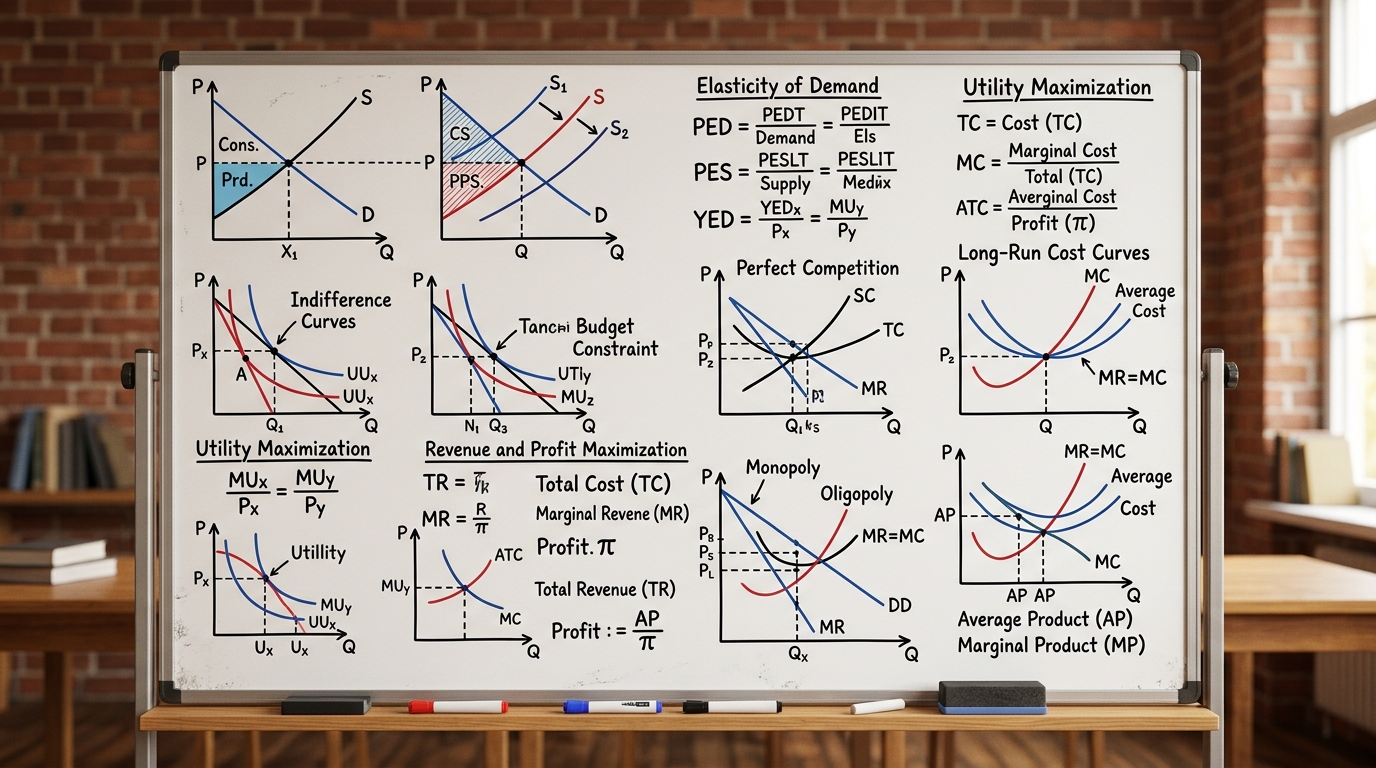
Microeconomics Formula Sheet & Key Theorems: The Complete DU Reference Guide
The ultimate cheat sheet for Intermediate Microeconomics I & II. Master Consumer Theory, Producer Theory, Market Structures, Game Theory, and Welfare Economics.
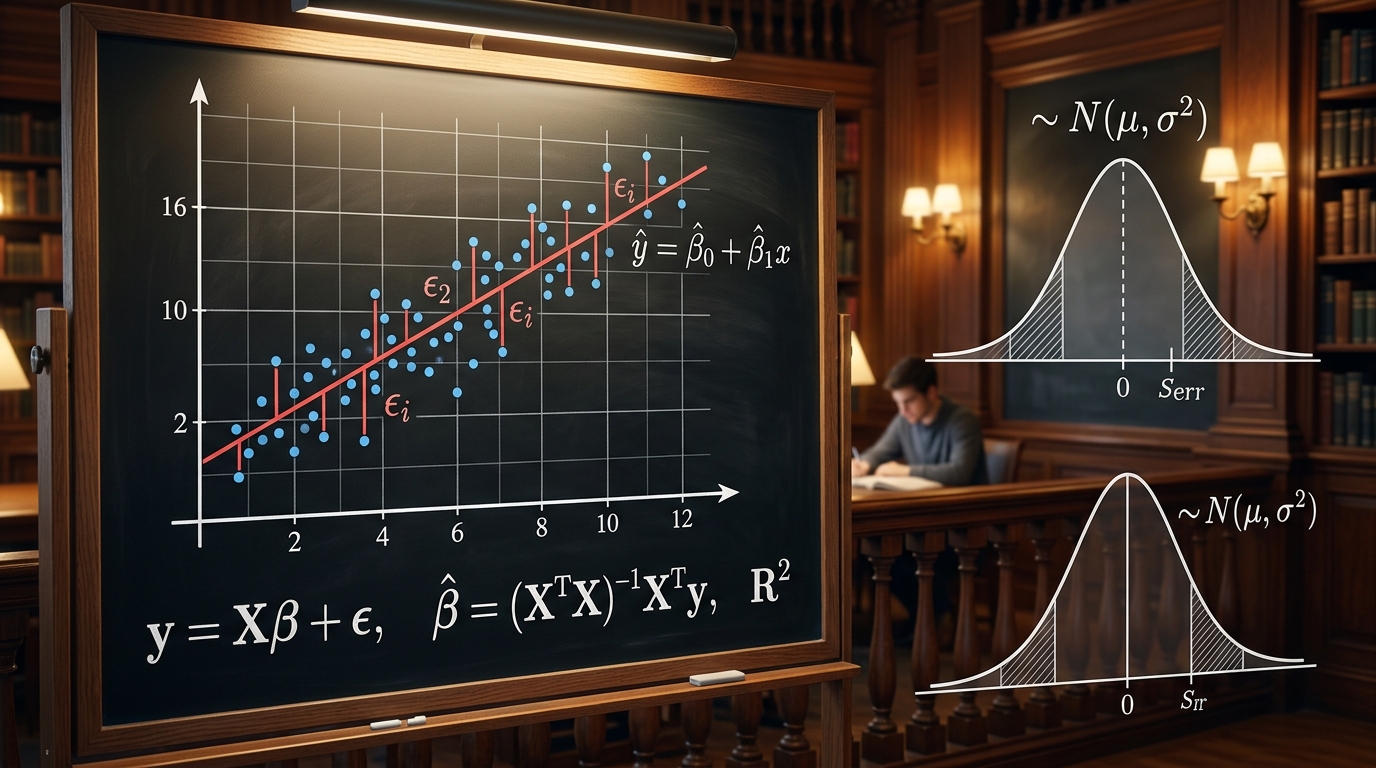
Introductory Econometrics & OLS Regression: Gauss-Markov Theorem, Proofs & Exam Numericals
Comprehensive 4,500-word masterclass on Introductory Econometrics and Ordinary Least Squares (OLS) for DU Economics students. Covers algebraic derivations of beta_0 and beta_1, Gauss-Markov BLUE proofs, R-squared variance decomposition, hypothesis testing (t and F-tests), and 3 fully worked numerical problems.
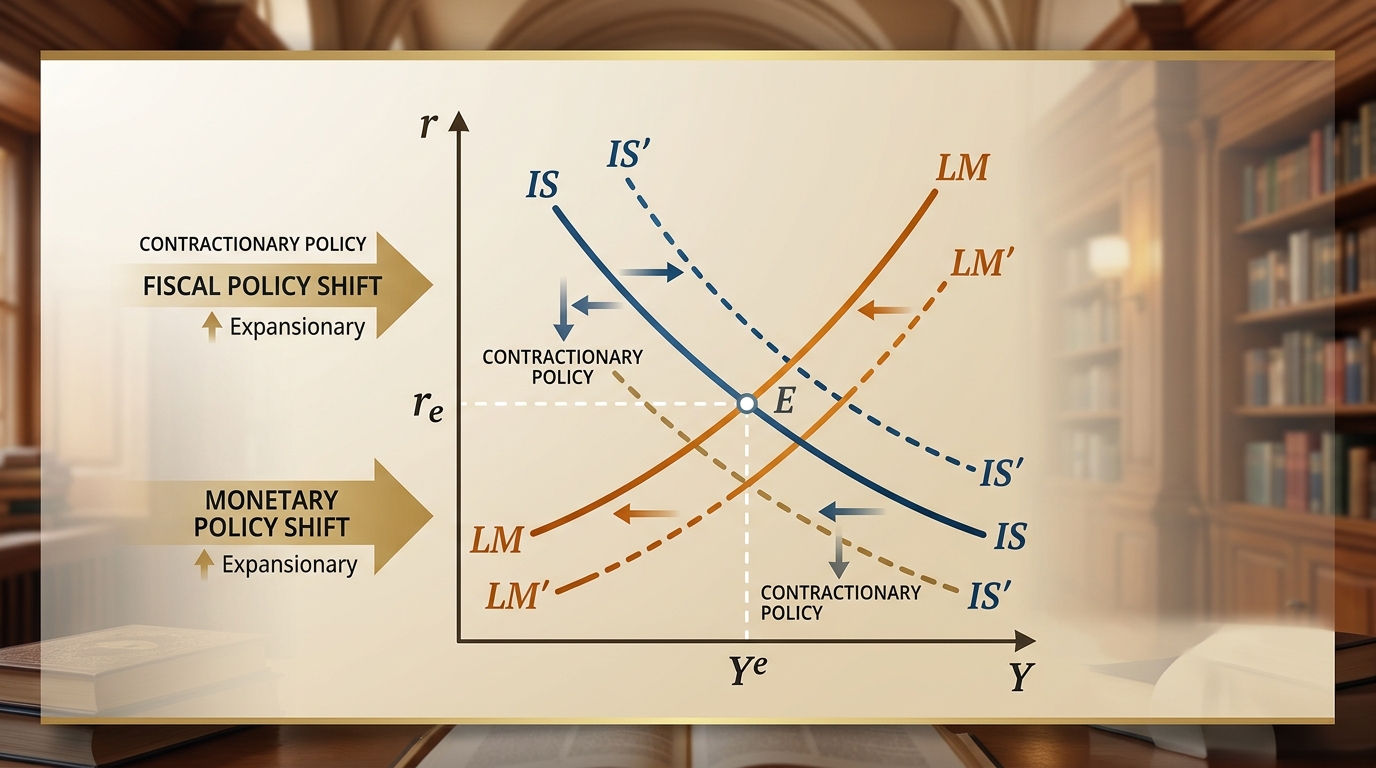
IS-LM Model: Goods & Money Market Equilibrium, Policy Multipliers & DU Exam Numericals
Comprehensive 4,000-word masterclass on the IS-LM model for DU Economics students. Covers algebraic derivations of IS and LM curves, general equilibrium, fiscal and monetary policy multipliers, crowding-out effect, liquidity trap, and 3 fully worked exam numericals.