Microeconomics Formula Sheet & Key Theorems: The Complete DU Reference Guide
The ultimate cheat sheet for Intermediate Microeconomics I & II. Master Consumer Theory, Producer Theory, Market Structures, Game Theory, and Welfare Economics.
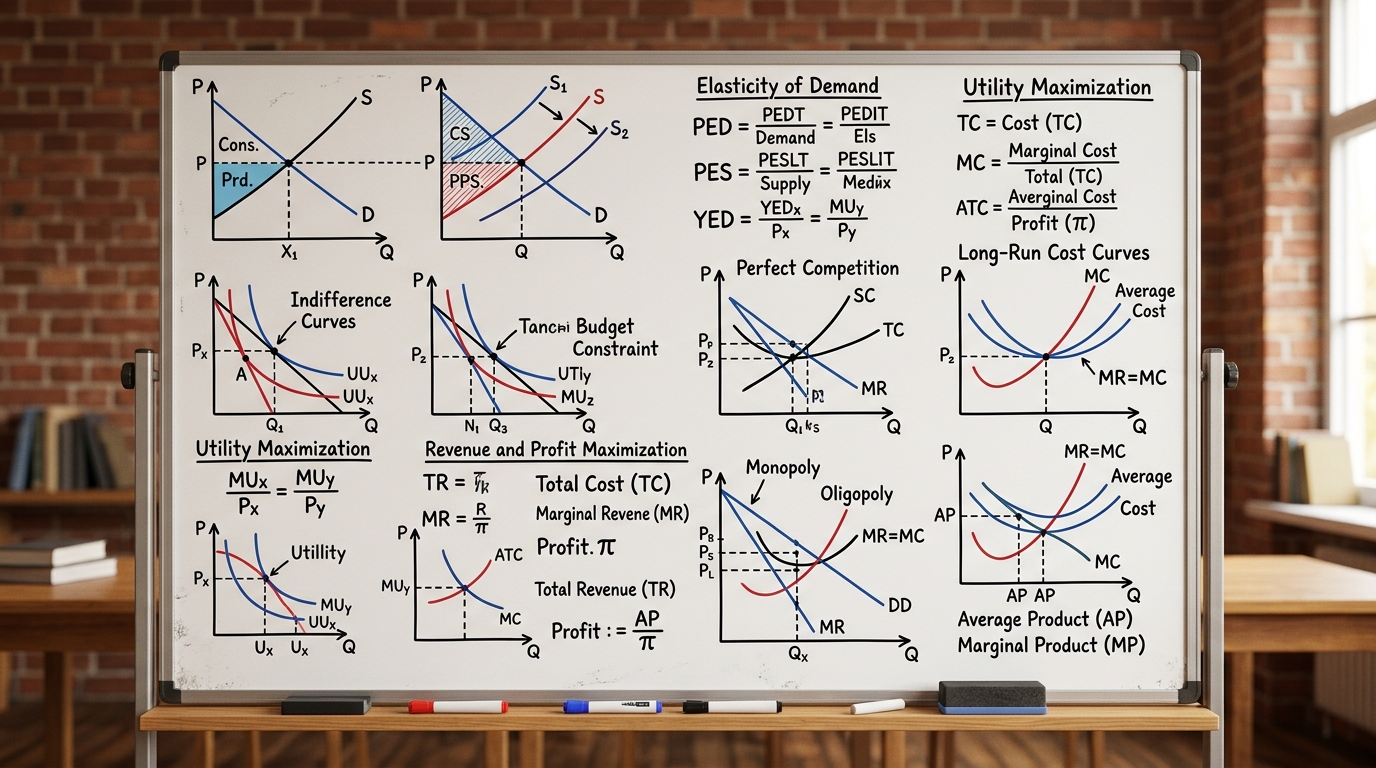
Microeconomics Formula Sheet & Key Theorems
The Complete DU Reference Guide for BA (Hons) Economics Students
1. Consumer Theory
Consumer theory forms the bedrock of microeconomics. Understanding how individuals maximize utility subject to budget constraints is essential.
| Concept | Formula / Condition | Definition & When to Use |
|---|---|---|
| Marginal Rate of Substitution (MRS) | MRS_xy = MU_x / MU_y | The rate at which a consumer can give up some amount of one good in exchange for another good while maintaining the same level of utility. |
| Utility Maximization | MRS_xy = P_x / P_y | Equating the slope of the indifference curve to the slope of the budget line. Used to find Marshallian demand functions. |
| Slutsky Equation | dx_i/dp_j = (dx_i/dp_j)_comp - x_j * (dx_i/dM) | Decomposes the effect of a price change into substitution and income effects. |
| Roy's Identity | x_i(p, M) = - (dV/dp_i) / (dV/dM) | Relates Marshallian demand to the indirect utility function V(p, M). |
| Shephard's Lemma | h_i(p, u) = dE(p, u)/dp_i | Relates Hicksian (compensated) demand to the expenditure function E(p, u). |
2. Producer Theory
Firms aim to maximize profits or minimize costs. The core concepts parallel consumer theory but apply to inputs and outputs.
| Concept | Formula / Condition | Definition & When to Use |
|---|---|---|
| Marginal Rate of Technical Substitution (MRTS) | MRTS_LK = MP_L / MP_K | The rate at which labor can be substituted for capital while holding output constant. |
| Cost Minimization | MRTS_LK = w / r | Equating the slope of the isoquant to the slope of the isocost line. Used to find conditional factor demands. |
| Returns to Scale | f(tL, tK) = t^n f(L, K) | If n > 1: Increasing RTS. If n = 1: Constant RTS. If n < 1: Decreasing RTS. |
3. Market Structures
Analyzing how firms behave under different competitive environments.
| Market Type | Key Equilibrium Condition | Description |
|---|---|---|
| Perfect Competition | P = MC | Firms are price takers. Zero economic profit in the long run (P = minimum AC). |
| Monopoly | MR = MC | Single seller. Price is higher and quantity is lower than under perfect competition. Mark-up depends on price elasticity of demand. |
| Cournot Duopoly | Max Pi_i given q_j | Firms compete on quantity simultaneously. Find the intersection of Best Response (BR) functions. |
| Bertrand Duopoly | P = MC (with identical costs) | Firms compete on price simultaneously. The outcome perfectly mirrors perfect competition if products are homogeneous. |
| Stackelberg Duopoly | Leader max Pi given Follower's BR | Sequential quantity competition. Leader has a first-mover advantage. |
4. Game Theory
Strategic interactions between rational decision-makers.
- Nash Equilibrium (Pure Strategy): A strategy profile where no player has an incentive to unilaterally deviate. Condition: Each player's strategy is a best response to the other players' strategies.
- Mixed Strategy Nash Equilibrium: Players randomize their strategies. Condition: A player is indifferent between the pure strategies they are randomizing over, because they yield the same expected payoff.
- Subgame Perfect Nash Equilibrium (SPNE): Relevant for sequential games. Found using backward induction. A strategy profile that constitutes a Nash Equilibrium in every subgame.
5. Welfare Economics
Evaluating the economic well-being of society.
- Pareto Efficiency: An allocation where it is impossible to make one person better off without making someone else worse off.
- Exchange Efficiency: MRS_A = MRS_B
- Production Efficiency: MRTS_X = MRTS_Y
- Product Mix Efficiency: MRT_XY = MRS_XY
- First Fundamental Theorem of Welfare Economics: Any Walrasian (competitive) equilibrium is Pareto efficient, under certain assumptions (e.g., no externalities, perfect information).
- Second Fundamental Theorem of Welfare Economics: Any Pareto efficient allocation can be achieved as a competitive equilibrium through a lump-sum redistribution of initial endowments.
- Social Welfare Functions: Aggregating individual utilities (U_i).
- Utilitarian: W = Sum(U_i)
- Rawlsian: W = Min(U_1, U_2, ..., U_n)
Bookmark this page for quick reference before your exams. These formulas are the foundation of microeconomic analysis at DU.
Frequently asked questions
What are the most important microeconomics formulas for DU exams?
The most important formulas include MRS = MUx/MUy = Px/Py for consumer equilibrium, the Slutsky Equation for substitution and income effects, MR = MC for profit maximization across all market structures, and Nash Equilibrium conditions for game theory problems.
How do I use the Slutsky Equation in numerical problems?
The Slutsky Equation decomposes total price effect into substitution effect (always negative) and income effect. For normal goods both effects reinforce each other; for Giffen goods the positive income effect dominates the negative substitution effect.
Dhairya sat the same DU papers he now writes about. Acadly is his attempt to say the useful things his own first-year self would have wanted to hear.
Keep reading

Introductory Econometrics & OLS Regression: Gauss-Markov Theorem, Proofs & Exam Numericals
Comprehensive 4,500-word masterclass on Introductory Econometrics and Ordinary Least Squares (OLS) for DU Economics students. Covers algebraic derivations of beta_0 and beta_1, Gauss-Markov BLUE proofs, R-squared variance decomposition, hypothesis testing (t and F-tests), and 3 fully worked numerical problems.
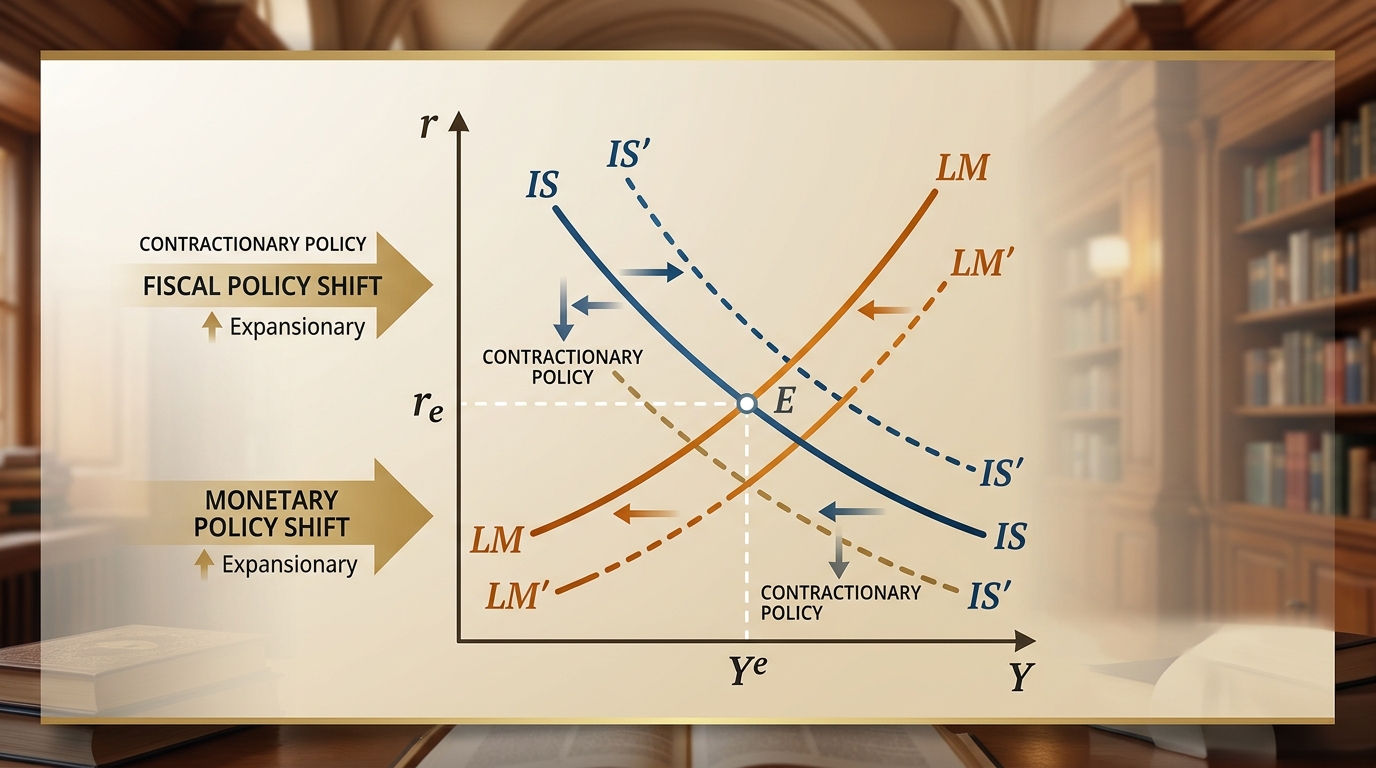
IS-LM Model: Goods & Money Market Equilibrium, Policy Multipliers & DU Exam Numericals
Comprehensive 4,000-word masterclass on the IS-LM model for DU Economics students. Covers algebraic derivations of IS and LM curves, general equilibrium, fiscal and monetary policy multipliers, crowding-out effect, liquidity trap, and 3 fully worked exam numericals.

Oligopoly Models: Cournot, Bertrand & Stackelberg — Complete Derivations & DU Exam Numericals
Comprehensive 4,000-word masterclass on Oligopoly Models for DU Economics students. Covers Cournot quantity competition, Bertrand price competition, Stackelberg leader-follower equilibrium, and 3 step-by-step worked numerical problems.