Solow Growth Model: Steady State, Golden Rule of Capital & Exam Numericals
Comprehensive 4,000-word masterclass on the Solow-Swan Neoclassical Growth Model for DU Economics students. Covers capital accumulation, steady state k*, Golden Rule level k*gold, technological progress, and 3 fully worked examination numericals.
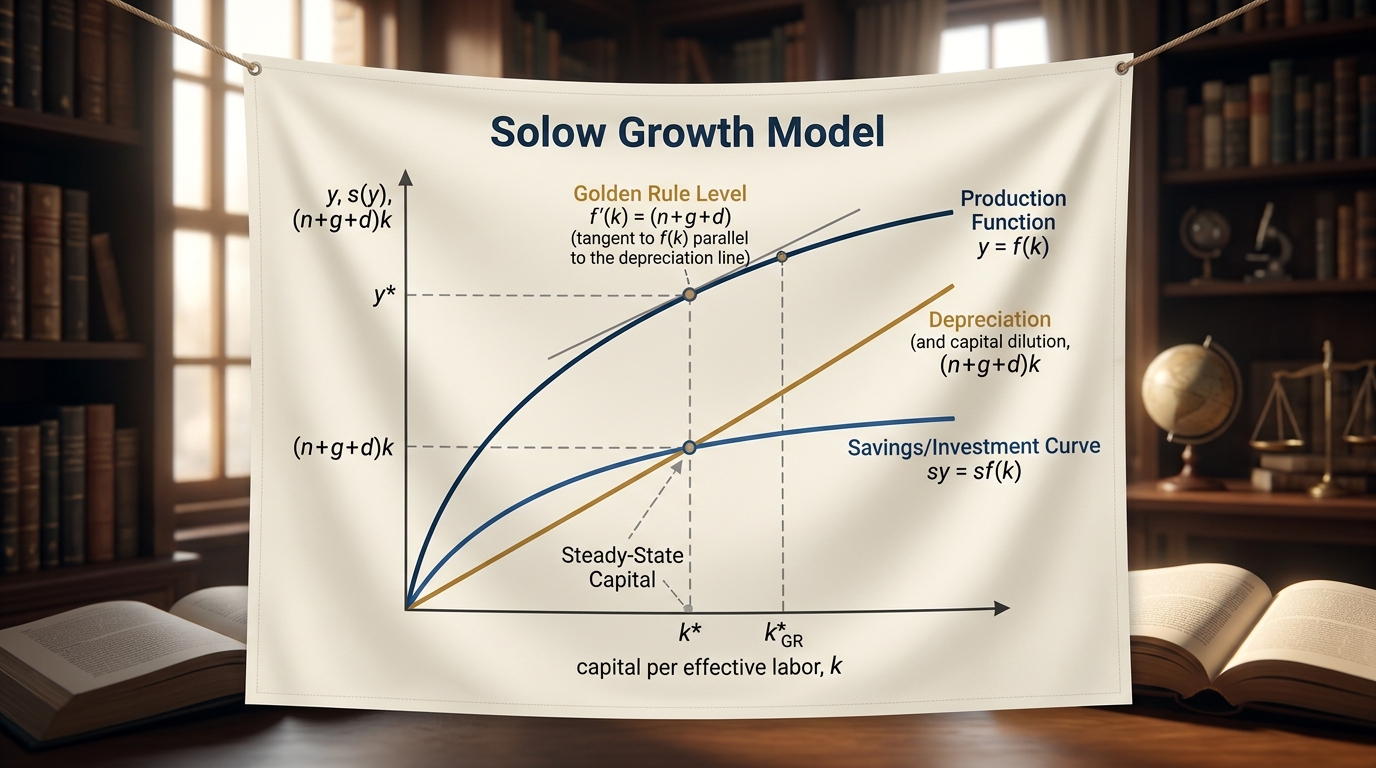
The Solow-Swan Neoclassical Growth Model (developed independently by Robert Solow and Trevor Swan in 1956) is the foundation of modern macroeconomic growth theory. It explains long-run economic growth by analyzing capital accumulation, population growth, and technological progress within an aggregate production framework.
For undergraduate students in Delhi University's B.A. (Hons) Economics and B.A. Programme (Intermediate Macroeconomics I & II), the Solow model represents a compulsory 15-mark to 20-mark numerical block in semester examinations.
In this 4,000-word masterclass guide, we derive the fundamental differential equation of capital accumulation, calculate the steady-state capital-labor ratio (k*), derive the Golden Rule level of capital (k*gold) that maximizes steady-state consumption, incorporate labor-augmenting technological progress, and solve 3 step-by-step examination numerical problems.
1. Model Assumptions & Production Function
The basic Solow model operates in a closed economy with no government sector. Output Y is produced using capital K and labor L via an aggregate Cobb-Douglas production function:
1.1 Intensive Form (Per-Worker Variables)
Since the production function exhibits Constant Returns to Scale (CRS), we divide by L to express all variables in intensive (per-worker) terms:
where k = K / L is the capital-labor ratio (capital intensity) and y = Y / L is output per worker.
1.2 Inada Conditions
The production function f(k) satisfies the standard Inada conditions:
- f(0) = 0
- f'(k) > 0 (positive marginal product of capital)
- f''(k) < 0 (diminishing marginal returns to capital)
- Limit of f'(k) as k approaches 0 is infinity
- Limit of f'(k) as k approaches infinity is 0
2. Capital Accumulation & Fundamental Solow Equation
Gross investment equals a constant savings rate s times aggregate output Y: I = s * Y. Capital depreciates at a constant rate delta, and the labor force grows at an exogenous rate n: (dL/dt) / L = n.
2.1 Derivation of Fundamental Equation
By definition, k = K / L. Taking the natural log and differentiating with respect to time t:
(1/k) * (dk/dt) = (1/K) * (dK/dt) - (1/L) * (dL/dt)
Note that dK/dt = s*Y - delta*K (net investment). Substitute into the equation:
Multiply both sides by k = K/L:
This is the Fundamental Differential Equation of the Solow Model. It states that the change in capital per worker (dk/dt) equals actual investment per worker [s * f(k)] minus required (break-even) investment per worker [(n + delta) * k].
3. Steady State Equilibrium (k*)
The economy reaches a Steady State when capital per worker is constant over time, i.e., dk/dt = 0.
For a Cobb-Douglas production function f(k) = k^alpha:
(k*)^(1 - alpha) = s / (n + delta)
3.1 Steady State Output and Consumption
- Steady State Output: y* = (k*)^alpha = [ s / (n + delta) ]^(alpha / (1 - alpha))
- Steady State Consumption: c* = (1 - s) * y* = (1 - s) * [ s / (n + delta) ]^(alpha / (1 - alpha))
4. The Golden Rule of Capital (k*gold)
Different savings rates lead to different steady states. A policy maker seeks the savings rate s_gold that maximizes steady-state consumption per worker c*.
4.1 Mathematical Derivation
In steady state, c* = f(k*) - (n + delta) * k*. Maximize c* with respect to k*:
Economic Interpretation: At the Golden Rule steady state, the Marginal Product of Capital (MPK) equals the break-even investment rate (n + delta).
4.2 Golden Rule Savings Rate for Cobb-Douglas
For f(k) = k^alpha, MPK = alpha * (k*)^(alpha - 1). Set MPK = n + delta:
alpha * [ (k*gold)^alpha / k*gold ] = n + delta ==> alpha * [ y*gold / k*gold ] = n + delta
Recall that in steady state, s_gold * y*gold = (n + delta) * k*gold. Divide the two equations:
Golden Rule Rule-of-Thumb: To maximize steady-state consumption, the savings rate must equal the capital share of income (alpha).
5. Technological Progress in Solow Model
To explain ongoing per-capita growth, we introduce labor-augmenting (Harrod-neutral) technological progress:
where A grows at an exogenous rate g: (dA/dt) / A = g. Variables are now expressed in effective worker terms: k_tilde = K / (A*L) and y_tilde = Y / (A*L).
Steady State: s * (k_tilde*)^alpha = (n + g + delta) * k_tilde*
| Variable | Notation | Steady State Growth Rate |
|---|---|---|
| Capital per Effective Worker | k_tilde = K / (A*L) | 0 (Constant) |
| Output per Worker | y = Y / L = A * y_tilde | g (Rate of Tech Progress) |
| Total Output | Y | n + g (Population + Tech Progress) |
6. Worked Examination Numerical Problems
Numerical Problem 1: Basic Solow Steady State (15 Marks)
Question: An economy has production function Y = K^(0.5) * L^(0.5). The savings rate is s = 0.2, depreciation rate delta = 0.05, and population growth rate n = 0.05.
(a) Find steady-state capital per worker k* and output per worker y*.
(b) Find steady-state consumption per worker c*.
(c) Find the Golden Rule capital stock k*gold and Golden Rule savings rate s_gold.
Solution:
Part (a): Steady State k* and y*
Production function in intensive form: y = f(k) = k^(0.5), so alpha = 0.5.
Steady state condition: s * k*^(0.5) = (n + delta) * k*
k* / k*^(0.5) = 0.2 / 0.10 = 2
(k*)^(0.5) = 2 ==> k* = 4
y* = f(4) = 4^(0.5) = 2
Part (b): Steady State Consumption c*
Part (c): Golden Rule k*gold and s_gold
Golden Rule condition: MPK = n + delta
(k*gold)^(-0.5) = 0.10 / 0.5 = 0.20
(k*gold)^(0.5) = 1 / 0.20 = 5 ==> k*gold = 25
Golden Rule savings rate:
y*gold = 25^(0.5) = 5
c*gold = (1 - 0.5) * 5 = 2.5
Numerical Problem 2: Technological Progress (15 Marks)
Question: Let Y = K^(0.3) * (A*L)^(0.7). Given s = 0.24, delta = 0.03, n = 0.02, g = 0.03.
Find steady-state capital per effective worker k_tilde*, output per effective worker y_tilde*, and growth rate of total output Y.
Solution:
Intensive form: y_tilde = k_tilde^(0.3), so alpha = 0.3.
Break-even rate: n + g + delta = 0.02 + 0.03 + 0.03 = 0.08.
0.24 * (k_tilde*)^0.3 = 0.08 * k_tilde*
(k_tilde*)^0.7 = 0.24 / 0.08 = 3
k_tilde* = 3^(1 / 0.7) = 3^(1.4286) = 4.81
y_tilde* = (4.81)^0.3 = 1.60
Growth rate of Total Output Y = n + g = 0.02 + 0.03 = 0.05 (or 5% per annum)
7. Summary & Exam Strategy Checklist
- Always write out the per-worker transformation y = f(k) first.
- Remember the steady state condition: actual investment s*f(k) = break-even investment (n + delta)*k.
- For Golden Rule, set MPK = n + delta (or n + g + delta if technology is present).
- For Cobb-Douglas, s_gold is simply alpha! Use this to quickly check your answer.
For related macroeconomics guides, see our Mundell-Fleming Model Guide and GDP Deflator vs CPI Masterclass.
Frequently asked questions
What is the Golden Rule of Capital in the Solow Model?
The Golden Rule is the steady-state capital-labor ratio k*gold that maximizes steady-state consumption per worker. It occurs where MPK = n + delta.
What happens to steady state capital when the savings rate increases?
An increase in savings rate s shifts the actual investment curve upward, increasing steady-state capital per worker k* and output per worker y*.
Dhairya sat the same DU papers he now writes about. Acadly is his attempt to say the useful things his own first-year self would have wanted to hear.
Keep reading
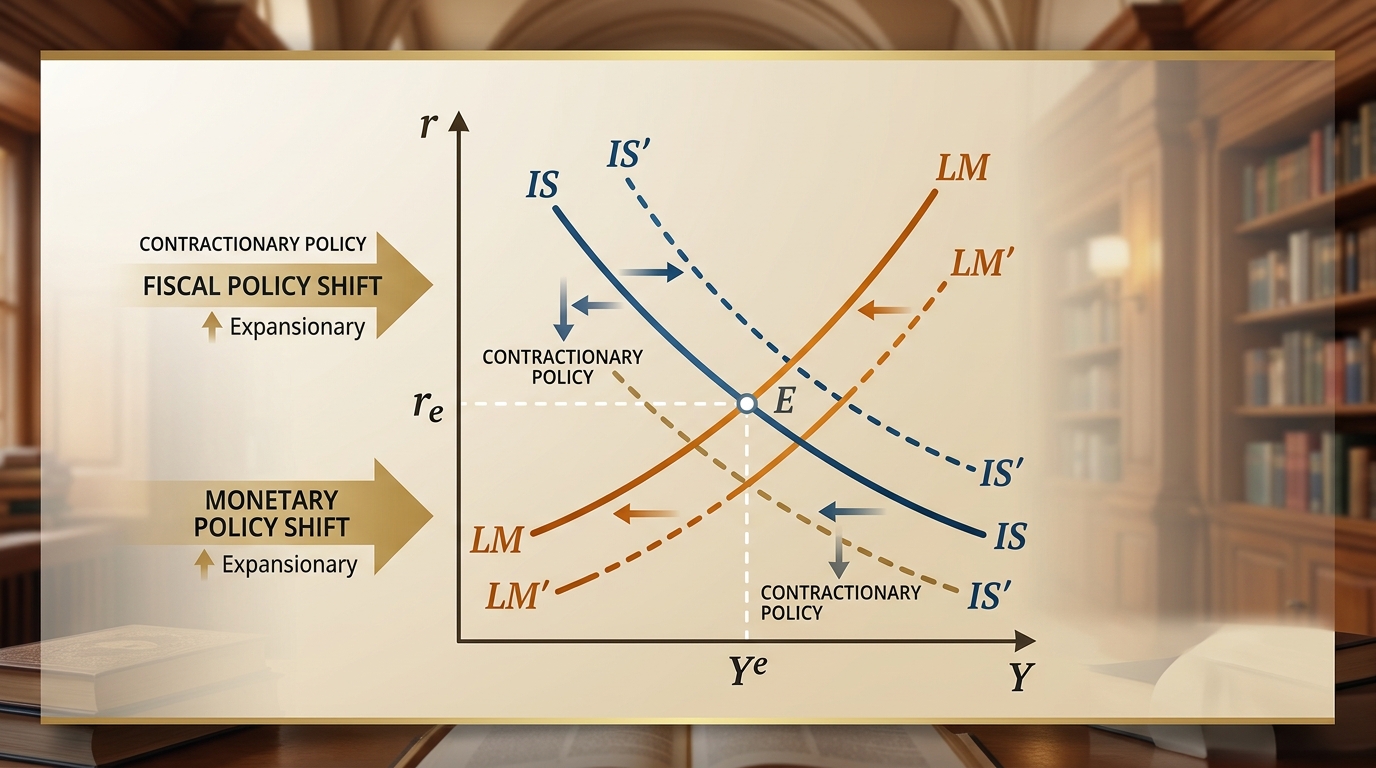
IS-LM Model: Goods & Money Market Equilibrium, Policy Multipliers & DU Exam Numericals
Comprehensive 4,000-word masterclass on the IS-LM model for DU Economics students. Covers algebraic derivations of IS and LM curves, general equilibrium, fiscal and monetary policy multipliers, crowding-out effect, liquidity trap, and 3 fully worked exam numericals.

Oligopoly Models: Cournot, Bertrand & Stackelberg — Complete Derivations & DU Exam Numericals
Comprehensive 4,000-word masterclass on Oligopoly Models for DU Economics students. Covers Cournot quantity competition, Bertrand price competition, Stackelberg leader-follower equilibrium, and 3 step-by-step worked numerical problems.
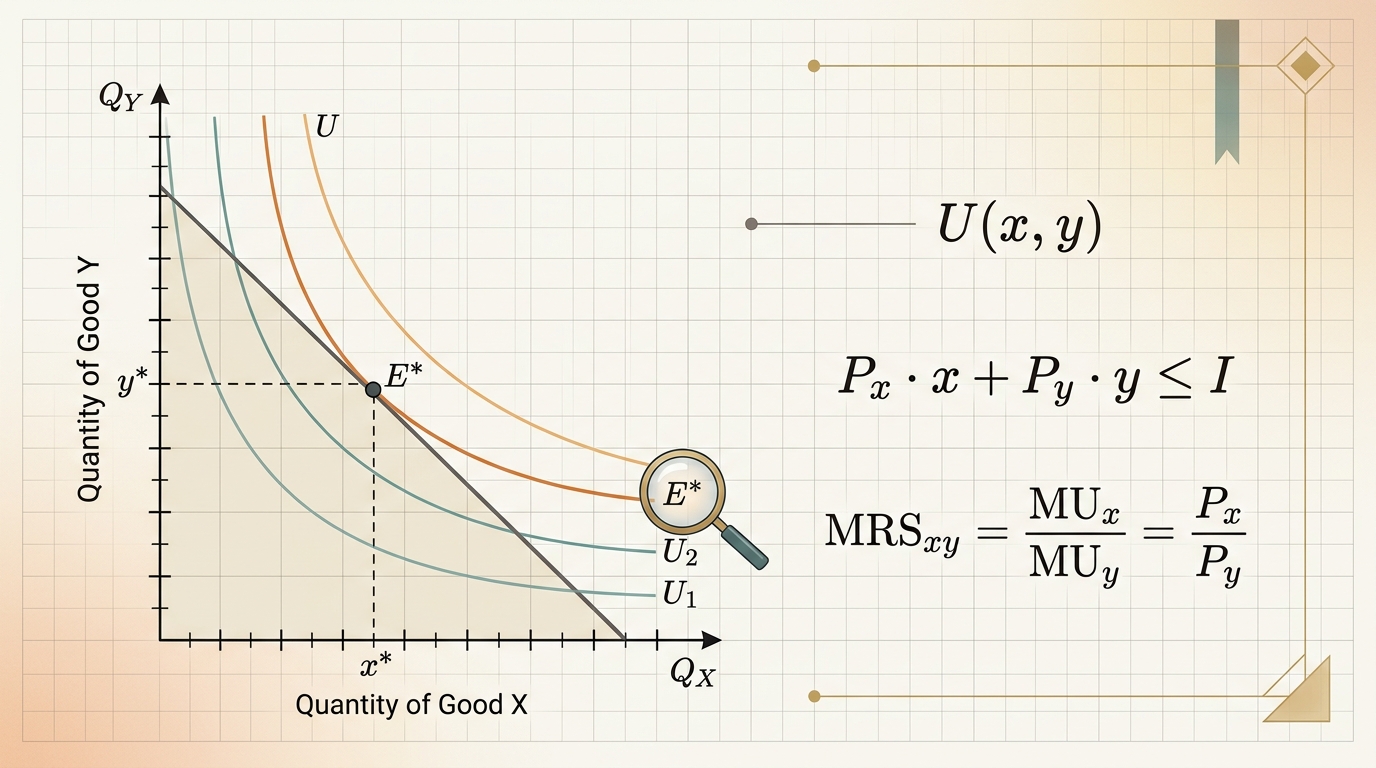
Consumer Theory & Indifference Curves: Utility Maximization, Budget Constraints & Exam Numericals
Comprehensive 4,000-word masterclass on Consumer Theory for DU Economics students. Covers utility functions, indifference curve properties, MRS derivation, budget constraint geometry, Lagrangian optimization, and 3 fully worked numerical problems.