DU College Transfer & Inter-College Migration Rules 2026: Eligibility, NOC & Application Process
Exhaustive 4,000-word guide on Delhi University Inter-College Migration for 2026. Covers 3rd semester transfer rules under UGCF 2022, NOC formats, CGPA eligibility, seat vacancy criteria, and step-by-step application walkthrough.
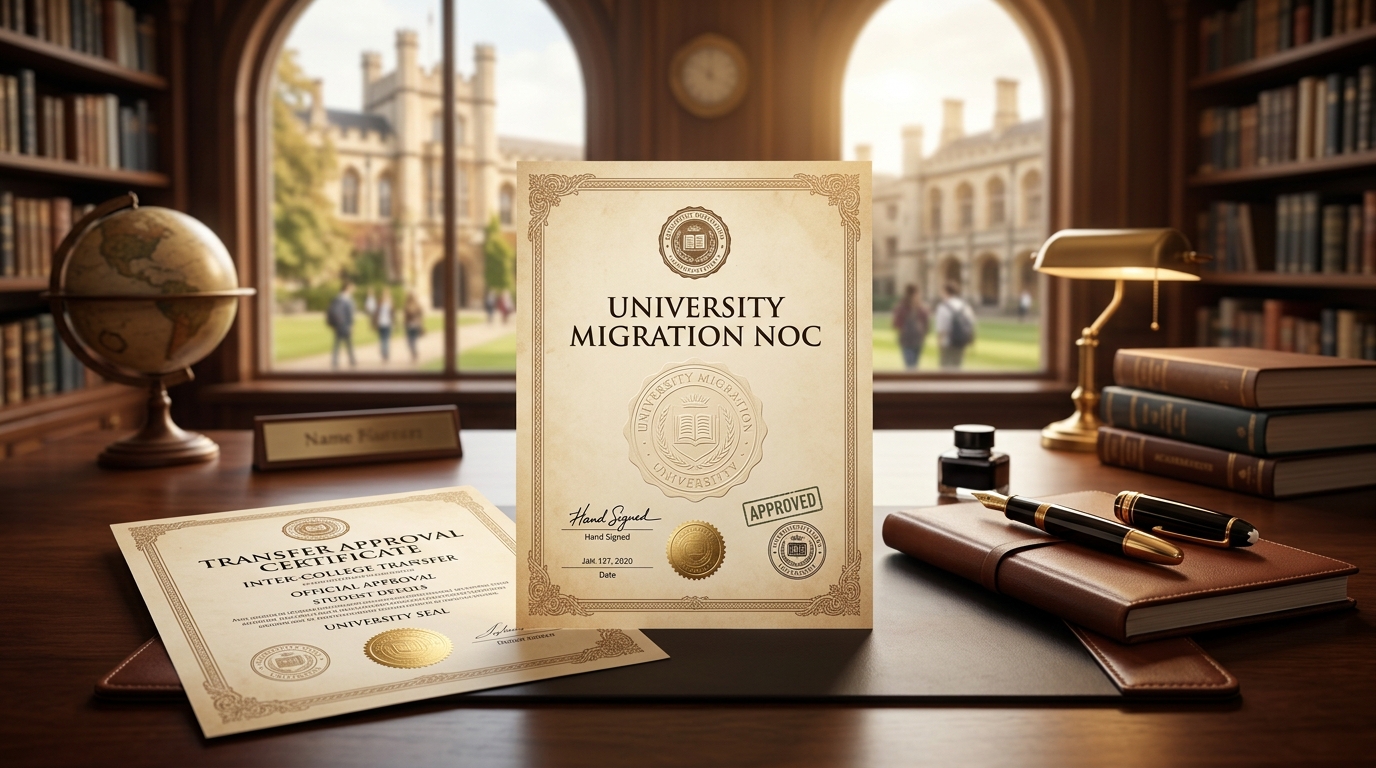
Many students who secure admission in off-campus or evening colleges during initial DU admission rounds hope to transfer to North or South Campus colleges later in their academic journey. In Delhi University administrative terminology, this formal transfer process between constituent colleges is known as Inter-College Migration.
Under Ordinance XII of Delhi University and the UGCF 2022 framework, inter-college migration is permitted strictly at the beginning of the 3rd Semester (2nd Year), subject to seat availability, academic merit, and No Objection Certificates (NOC) from both participating colleges.
In this 4,000-word masterclass guide, we break down the 2026 inter-college migration rules, eligibility criteria, step-by-step application walkthrough, NOC procurement procedures, and realistic success rates across top DU colleges.
1. Legal Framework: DU Ordinance XII & UGCF 2022 Rules
Inter-college migration in DU is governed by Ordinance XII (Clause 4) of the University Calendar and guidelines issued by the Dean of Colleges.
1.1 Mandatory Conditions for Eligibility
- Timing: Migration is allowed ONLY at the start of Semester III (Year 2). No migration is permitted during Semester I, II, IV, V, or VI.
- Same Course Requirement: Migration is allowed ONLY within the exact same degree program (e.g., B.A. (Hons) Economics to B.A. (Hons) Economics, or B.Com (Hons) to B.Com (Hons)). You CANNOT change your course during migration.
- Clear Academic Record: The candidate must have cleared all papers of Semester I and Semester II without any Essential Repeat (ER) or backlogs.
- Seat Vacancy: A vacant seat must exist in the target college in the candidate's specific program and category (UR, OBC, SC, ST, EWS, PwBD).
- Dual NOC Requirement: NOC must be issued by the Principal of the releasing college AND accepted by the Principal of the receiving college.
Migration is strictly prohibited for: (a) students admitted under Sports / ECA quota, (b) students studying in SOL or NCWEB migrating to regular colleges (and vice versa, except under special Senate relaxation), and (c) postgraduate programs.
2. Step-by-Step Migration Application Walkthrough
Step 1: Check Seat Vacancies (July – Early August)
At the end of Semester II exam results, target colleges release notices on their official websites advertising vacant seats in 3rd Semester courses. Keep a daily tracker of North/South Campus college websites (e.g., Hindu, Ramjas, Kirori Mal, Venkateswara, Gargi).
Step 2: Obtain NOC from Releasing College
Submit a formal application to the Principal of your current college requesting a No Objection Certificate (NOC) for Migration. State your academic track record (Sem I & II SGPA) and valid reasons for transfer (e.g., distance/commute, academic facilities).
Step 3: Apply to Receiving College
Submit your migration application to the target college along with:
- NOC from releasing college
- Sem I & Sem II official DU marksheets / transcripts
- Class 10 & Class 12 marksheets
- Category certificate (if applicable)
- Character Certificate from current college
Step 4: Merit List & Approval by University Registrar
If applicants exceed vacant seats, the receiving college prepares a merit list based on 1st Year CGPA. Once selected, the migration dossier is forwarded to the DU Academic Branch (North Campus) for final approval by the Registrar.
3. Realistic Success Rates & CGPA Thresholds
| Target College Tier | Average Vacant Seats / Course | Competitive Cutoff CGPA (1st Year) |
|---|---|---|
| Top North Campus (Hindu / SRCC / Hansraj / Miranda) | 0 to 2 seats (Extremely rare) | 9.20+ CGPA |
| Mid North / South Campus (KMC / Ramjas / Venky / Gargi) | 2 to 5 seats | 8.50 – 9.10 CGPA |
| Off-Campus Colleges (ARSD / DCAC / SGTB Khalsa) | 5 to 10 seats | 7.80 – 8.40 CGPA |
4. Inter-University Migration Rules
Students transferring to DU from another recognized Indian university (e.g., BHU, Jamia Millia Islamia, Panjab University) follow separate Inter-University Migration guidelines.
- Allowed ONLY at the start of Semester III.
- Requires Equivalence Certificate from DU Equivalence Committee proving syllabus matching (at least 80% course content overlap).
- Requires Migration Certificate from parent university.
For CGPA calculation methods, see our SGPA to CGPA Calculation Masterclass and DU Grading & Attendance Rules.
Frequently asked questions
When can I apply for inter-college migration at Delhi University?
Migration is allowed strictly at the beginning of Semester III (Year 2) after Semester I and II results are declared.
Can I change my course during inter-college migration?
No. Migration is permitted only within the exact same degree course (e.g. B.Com Hons to B.Com Hons).
Dhairya sat the same DU papers he now writes about. Acadly is his attempt to say the useful things his own first-year self would have wanted to hear.
Keep reading

DU Library System & Digital Archives 2026: Central Library, OPAC, N-LIST & JSTOR Access
Exhaustive 4,000-word guide to Delhi University's library network in 2026. Covers Central Library (Arts Faculty), Ratan Tata Library (DSE), OPAC catalogue search, INFLIBNET N-LIST portal, JSTOR remote VPN access, and inter-library borrowing.
DU Societies & Clubs 2026: How to Join, Audition Tips & Top Societies Across North/South Campus
Comprehensive 4,000-word guide to joining Delhi University college societies and clubs for 2026-27. Covers audition and interview processes, top societies across debate, drama, economics, photography, and music, plus tips for building a strong extracurricular portfolio.
DU Fresher Orientation & Induction Week 2026: What to Expect, What to Carry & How to Prepare
Complete 4,000-word guide to Delhi University fresher orientation week for 2026-27 session. Covers department-wise induction schedules, what to carry on Day 1, SAMARTH portal setup, library card registration, and first-week survival checklist.