How to Calculate SGPA and CGPA in Delhi University (UGCF 2022): 2026 Guide
Exhaustive 4,500-word mathematical breakdown of Delhi University's UGCF 2022 grading system. Includes SGPA calculations, CGPA to percentage conversions, improvement exam rules, and Dean's List criteria.
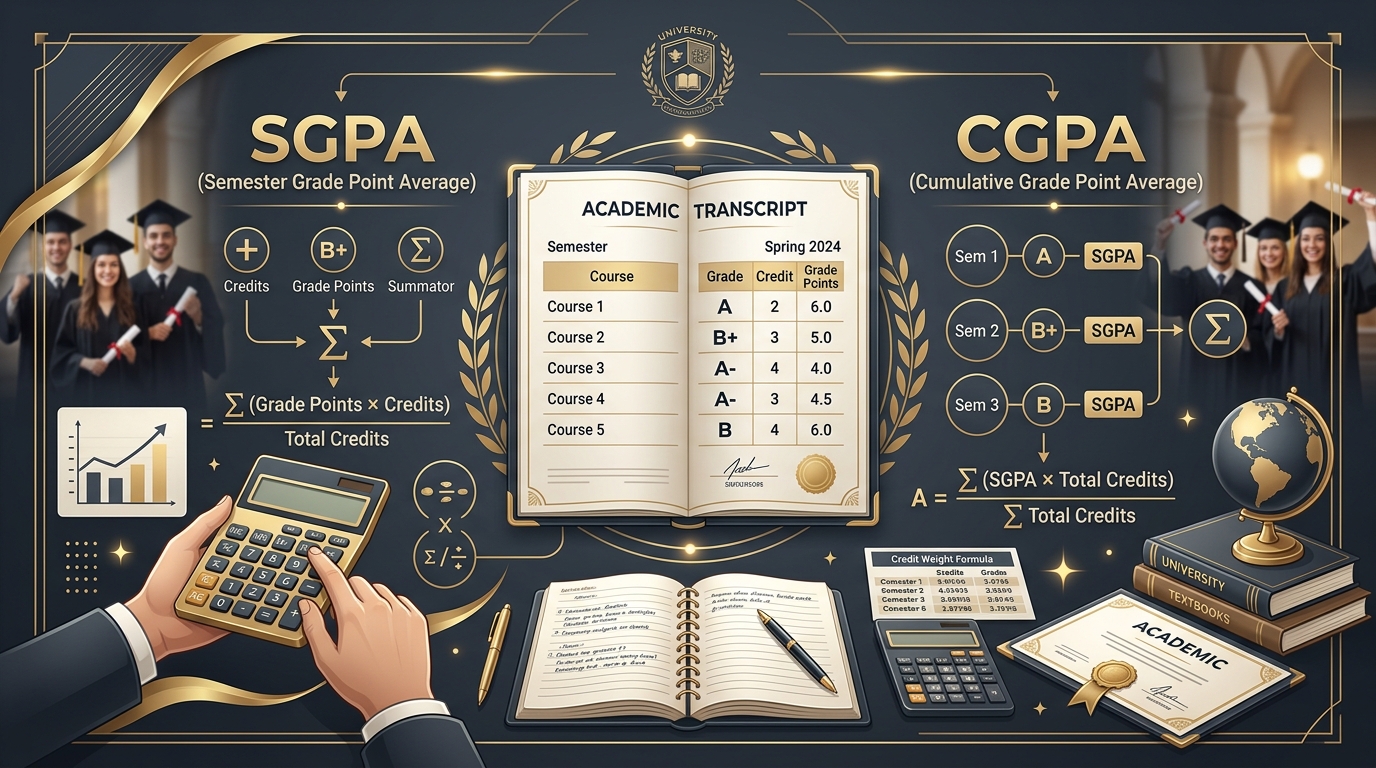
Under the National Education Policy (NEP) and the Undergraduate Curriculum Framework (UGCF) 2022, Delhi University transitioned to a strict credit-based grading system. Gone are the days of simple percentages. Today, your academic worth is measured in Grade Points, Semester Grade Point Average (SGPA), and Cumulative Grade Point Average (CGPA). Understanding the mathematical mechanics behind this system is crucial for securing scholarships, qualifying for elite Master's programs, and strategically deciding which papers to submit for improvement exams. This exhaustive 2026 guide provides fully worked numerical examples of SGPA and CGPA calculations, the exact DU formula for percentage conversion, and the harsh reality of an 'F' grade.
1. The UGCF 2022 Grading Scale
Every subject you study is assigned a specific number of Credits (Ci). Based on your total marks (Internal Assessment + End Semester Exam), you are awarded a Letter Grade, which corresponds to a Grade Point (GPi) out of 10.
| Letter Grade | Classification | Grade Point (GPi) |
|---|---|---|
| O (Outstanding) | Top percentile | 10 |
| A+ (Excellent) | Very High | 9 |
| A (Very Good) | High | 8 |
| B+ (Good) | Above Average | 7 |
| B (Above Average) | Average | 6 |
| C (Average) | Passable | 5 |
| P (Pass) | Marginal Pass | 4 |
| F (Fail) | Failed | 0 |
| Ab (Absent) | Did not appear | 0 |
2. Three Fully Worked SGPA Calculation Examples
The formula for Semester Grade Point Average (SGPA) is the weighted average of your Grade Points, where the weights are the Credits of the respective courses:
SGPA = Sum(Ci × GPi) / Sum(Ci)
Where Ci = Credits of the ith course, GPi = Grade Point secured in the ith course.
Example 1: A Standard Semester (No Fails)
Let's calculate the SGPA for a student taking 3 Cores, 1 GE, 1 SEC, 1 VAC, and 1 AEC.
- Core 1: 4 Credits | Grade: A (8) | Points = 4 × 8 = 32
- Core 2: 4 Credits | Grade: A+ (9) | Points = 4 × 9 = 36
- Core 3: 4 Credits | Grade: B+ (7) | Points = 4 × 7 = 28
- GE 1: 4 Credits | Grade: O (10) | Points = 4 × 10 = 40
- SEC 1: 2 Credits | Grade: A (8) | Points = 2 × 8 = 16
- VAC 1: 2 Credits | Grade: A+ (9) | Points = 2 × 9 = 18
- AEC 1: 2 Credits | Grade: B (6) | Points = 2 × 6 = 12
Total Credits Sum(Ci) = 4+4+4+4+2+2+2 = 22
Total Points Sum(Ci × GPi) = 32+36+28+40+16+18+12 = 182
SGPA = 182 / 22 = 8.27
Example 2: The Impact of an 'F' Grade
If a student fails a core paper (F grade = 0 points), it tanks the SGPA heavily because the 4 credits remain in the denominator.
- Core 1: 4 Credits | Grade: F (0) | Points = 4 × 0 = 0
- Core 2: 4 Credits | Grade: A (8) | Points = 4 × 8 = 32
- Core 3: 4 Credits | Grade: B+ (7) | Points = 4 × 7 = 28
- GE 1: 4 Credits | Grade: A (8) | Points = 4 × 8 = 32
- SEC/VAC/AEC (Combined 6 Credits): Grade B+ average (7) | Points = 6 × 7 = 42
Total Credits Sum(Ci) = 22
Total Points Sum(Ci × GPi) = 0+32+28+32+42 = 134
SGPA = 134 / 22 = 6.09 (A massive drop despite decent grades in other subjects).
Example 3: Heavily Weighted Towards 2-Credit Courses
Students often score 'O' in VAC/SEC, but since they are only 2 credits, the SGPA pull is limited.
- Cores + GE (16 Credits): All C grade (5) | Points = 16 × 5 = 80
- SEC + VAC + AEC (6 Credits): All O grade (10) | Points = 6 × 10 = 60
Total Credits = 22
Total Points = 140
SGPA = 140 / 22 = 6.36. Conclusion: You cannot rely on 2-credit electives to save poor Core grades.
3. Two Fully Worked CGPA Calculation Examples
Cumulative Grade Point Average (CGPA) is NOT the simple average of your SGPAs. It is the total points earned across all semesters divided by the total credits attempted.
CGPA Example 1: Consistent Performer (4 Semesters)
- Sem 1: 22 Credits | SGPA 8.00 | Points = 22 × 8.00 = 176
- Sem 2: 22 Credits | SGPA 8.50 | Points = 22 × 8.50 = 187
- Sem 3: 22 Credits | SGPA 7.50 | Points = 22 × 7.50 = 165
- Sem 4: 22 Credits | SGPA 8.18 | Points = 22 × 8.18 = 180
Total Credits = 88
Total Points = 176 + 187 + 165 + 180 = 708
CGPA = 708 / 88 = 8.04
CGPA Example 2: The Comeback (Recovery from an F)
Student fails a 4-credit course in Sem 1, clears it as an ER (Essential Repeat) in Sem 3.
- Sem 1: 22 Credits | SGPA 6.09 (due to F) | Points = 134
- Sem 2: 22 Credits | SGPA 8.00 | Points = 176
- Sem 3 (Regular): 22 Credits | SGPA 8.00 | Points = 176
- Sem 3 (ER Exam for Sem 1 subject): Replaces F (0) with an A (8) in the master record. This adds 4 × 8 = 32 points back to Sem 1's tally.
New Sem 1 Points = 134 + 32 = 166. New Sem 1 SGPA = 7.54.
Total Credits (after 3 sems) = 66
Total Points = 166 (S1) + 176 (S2) + 176 (S3) = 518
New CGPA = 518 / 66 = 7.84
4. Official CGPA to Percentage Conversion
Unlike the older CBCS system which used a (CGPA × 9.5) multiplier, Delhi University's official notification under the new grading scheme strictly mandates:
Percentage = CGPA × 10
Examples:
- A CGPA of 8.27 = 82.7%
- A CGPA of 6.54 = 65.4%
This makes DU's system much easier to understand compared to IITs/NITs, where a 10-point CGPA often does not map linearly to percentage.
5. Improvement Exams and ER Rules under UGCF 2022
If you are unhappy with a passing grade (e.g., you got a 'C' and want an 'A'), you can file for an Improvement Exam.
- Odd/Even Rule: You can only improve odd semester papers during odd semester exams (e.g., Sem 1 paper in Sem 3), and even during even.
- Best of Two: DU takes the higher of the two grades. If you score worse in your improvement attempt, your original better grade remains intact.
- Essential Repeat (ER): If you get an F, it is an ER. You MUST clear it to get your degree. It follows the same Odd/Even timeline.
- Official Transcript: Your final DU transcript will show the final grade. It will not explicitly stamp "Improvement" next to the subject, which is highly beneficial for postgraduate admissions abroad.
6. Thresholds: Scholarships, Placements, and Master's Degrees
What is a "good" CGPA in DU? It depends heavily on your course (Arts vs Science), but generally:
- 9.0+ CGPA (Outstanding): Rare. Guarantees Dean's List (if instituted by your college). Essential for full scholarships at US/UK PhD programs.
- 8.0 - 8.9 CGPA (Excellent): Clears all corporate placement cut-offs (McKinsey, Bain, top banks). Highly competitive for Ivy League Master's.
- 7.0 - 7.9 CGPA (Good): Clears the basic eligibility (usually 60% or 6.0 CGPA) for Indian Master's entrances like DSE and IGIDR. May struggle with top-tier corporate shortlists.
- Below 6.0 CGPA: Problematic. Disqualifies you from many entrance exams that require a minimum of 60% aggregate.
7. Internal Linkages & Strategic Course Planning
Your SGPA is mathematically constrained by the subjects you choose. To optimize your grades, you must choose your electives wisely. Read our DU GE, SEC, and VAC Course Selection Guide to ensure you don't accidentally pick GPA-tanking subjects.
If you are maintaining a high CGPA specifically to crack elite economics entrances, prepare yourself by exploring the curriculum differences in our IGIDR vs DSE Comparison. And if you are an Economics student currently struggling with core mathematical concepts, refer to our detailed proofs on the Cobb-Douglas Production Function and the Mundell-Fleming Model to secure that A+ in your finals.
Frequently asked questions
What is the formula to convert DU CGPA into percentage?
Multiply your CGPA by 9.5 (Percentage = CGPA x 9.5).
Dhairya sat the same DU papers he now writes about. Acadly is his attempt to say the useful things his own first-year self would have wanted to hear.
Keep reading

DU North Campus Hostel Mess & PG Food Survival Guide 2026: Menus, Hygiene & Cost
Exhaustive 4,000-word food survival guide for Delhi University students in 2026. Covers North/South Campus hostel mess menus, monthly mess fees, PG tiffin services, food hubs, and nutrition management.

DU Equal Opportunity Cell (EOC) 2026: PwBD Admission Reservation, Assistive Devices & Grievances
Exhaustive 4,000-word guide on Delhi University Equal Opportunity Cell (EOC) for 2026. Covers 5% PwBD reservation rules, scribe allocation, assistive technology labs, and grievance redressal.

DU Scholarships & Fee Concession 2026: FSS, NSP & College-Level Aid — Complete Application Guide
Exhaustive 4,000-word guide on every scholarship and fee concession available to Delhi University students in 2026. Covers FSS, NSP, college-level aid, SC/ST/OBC/EWS schemes, and step-by-step application processes.