Elasticity of Demand: Mathematical Formulas, Indian Market Case Studies & Exam Numericals
Price, income, and cross elasticity of demand explained with Indian market data. Point/Arc calculus derivations, MR-P-Elasticity proofs, 4 worked numericals, Delhi Metro & petrol case studies, and DU exam answer steps.
Price elasticity of demand (Ep) measures the responsiveness of quantity demanded of a commodity to a change in its price. In microeconomics papers across Delhi University and central universities, examiners expect both calculus derivations (Point vs Arc Elasticity) and real-world empirical examples from the Indian market documented by MoSPI and NITI Aayog.
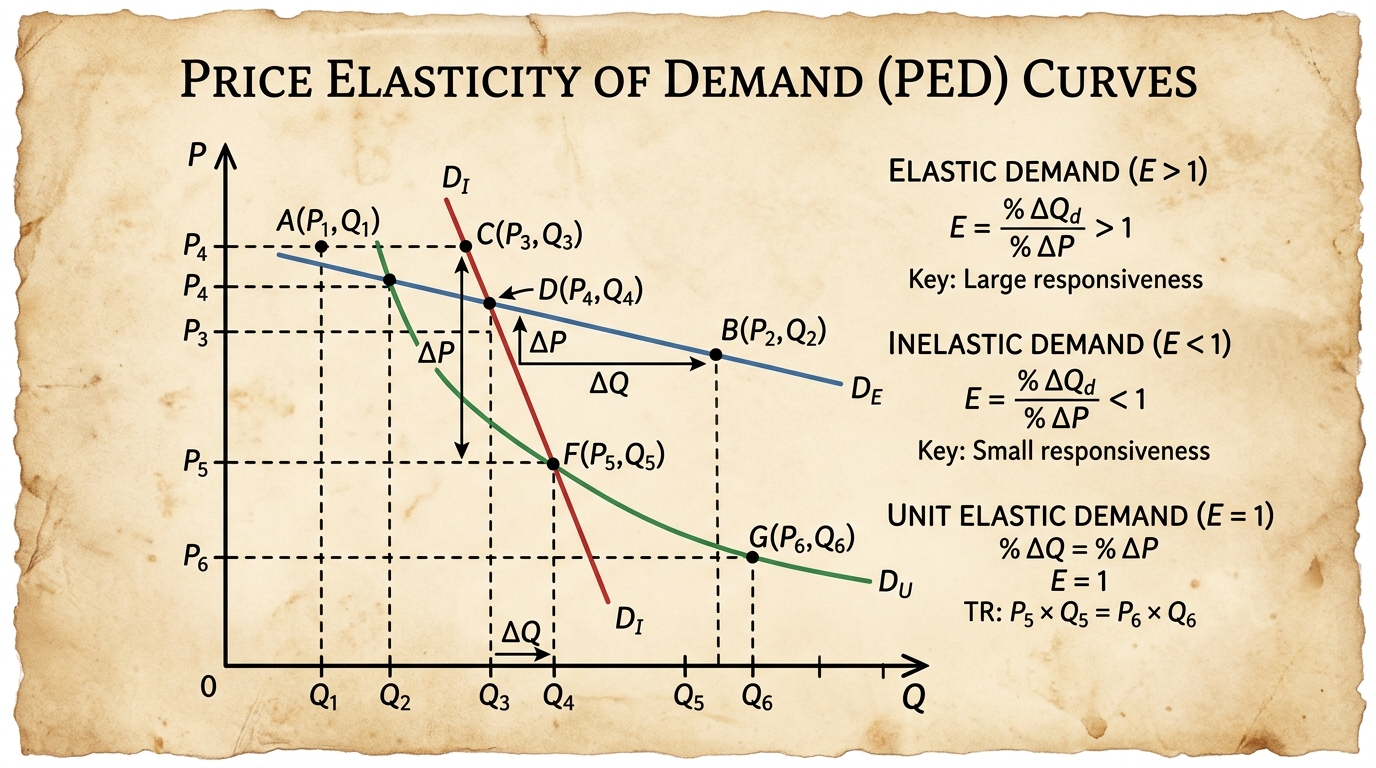
1. Mathematical Formulations: Point vs. Arc Elasticity
Point Price Elasticity (Calculus Formulation)
For a continuous demand function Q = f(P), point elasticity at a specific price-quantity point is:
Ep = (% Change in Q) / (% Change in P) = (dQ / dP) × (P / Q)
Arc Price Elasticity (Midpoint Formula)
When measuring elasticity over a discrete price interval between (P1, Q1) and (P2, Q2):
Earc = [(Q2 - Q1) / ((Q1 + Q2)/2)] ÷ [(P2 - P1) / ((P1 + P2)/2)] = [(Q2 - Q1)/(P2 - P1)] × [(P1 + P2)/(Q1 + Q2)]
2. Mathematical Proof: Marginal Revenue, Price, & Elasticity
Total Revenue TR is defined as TR = P × Q, where P = f(Q) is the inverse demand function.
Marginal Revenue MR is the derivative of Total Revenue with respect to Q:
MR = d(TR)/dQ = d(P × Q)/dQ = P + Q × (dP/dQ)
Factoring out P:
MR = P × [ 1 + (Q / P) × (dP / dQ) ]
Since Ep = (dQ / dP) × (P / Q), we have (Q / P) × (dP / dQ) = 1 / Ep:
MR = P × [ 1 - 1 / |Ep| ]
Implications of the MR Formula:
- If |Ep| > 1 (Elastic): 1 / |Ep| < 1 ⟹ MR > 0. Lowering price increases total revenue.
- If |Ep| = 1 (Unit Elastic): 1 / |Ep| = 1 ⟹ MR = 0. Total revenue is maximized.
- If |Ep| < 1 (Inelastic): 1 / |Ep| > 1 ⟹ MR < 0. Lowering price decreases total revenue.
3. Worked 10-Mark Exam Numericals
Given linear demand function Q = 500 - 20P:
(a) Calculate point price elasticity at P = 10.
(b) Calculate arc price elasticity when price increases from P1 = 10 to P2 = 15.
(c) Determine the total revenue maximizing price P_TR_max. [10 Marks]
Solution Breakdown
- Part (a): Point Elasticity at P = 10
At P = 10, Q = 500 - 20(10) = 300. Derivative dQ/dP = -20.
Ep = -20 × (10 / 300) = -200 / 300 = -0.67 (Inelastic, |Ep| < 1). - Part (b): Arc Elasticity between P1 = 10 (Q1 = 300) and P2 = 15 (Q2 = 200)
Earc = [(200 - 300) / (15 - 10)] × [(10 + 15) / (300 + 200)] = [-100 / 5] × [25 / 500] = -20 × 0.05 = -1.0 (Unit Elastic). - Part (c): Total Revenue Maximizing Price
Total Revenue TR = P × Q = P(500 - 20P) = 500P - 20P².
dTR/dP = 500 - 40P = 0 ⟹ P_TR_max = 12.5.
4. Empirical Indian Market Case Studies
- Inelastic Demand (|Ep| < 1): Petrol & Essential Medicines
Data published by the Petroleum Planning & Analysis Cell under the Ministry of Petroleum and Natural Gas shows retail fuel demand in urban India exhibits low short-run price elasticity (~ -0.2). Commuters have limited immediate public transit substitutes, making fuel consumption price-inelastic. - Cross-Price Elasticity (Exy > 0): Delhi Metro vs DTC Buses
When Delhi Metro fare revisions were implemented, commuter demand showed positive cross-elasticity between metro transit and municipal bus lines operated by DTC, illustrating classic substitute dynamics.
5. Related Micro & Quantitative Guides
For further practice on mathematical microeconomics and calculus techniques, check our guides on MME Survival & Distinction Guide and GDP Deflator vs CPI Inflation Analysis.
Frequently asked questions
Why is petrol demand called inelastic in India?
Because most consumers can't quickly change vehicles or routes when prices rise. Over years, demand does adjust, so short-run elasticity is low, long-run elasticity is higher.
Are onions elastic or inelastic?
Onions are inelastic in the short run because they're a staple with limited substitutes in Indian cooking, which is why price spikes hit household budgets sharply.
What's a good exam answer for income elasticity?
Define it precisely, give one necessity (rice, near zero elasticity) and one luxury (foreign travel, elasticity above one) example, and mention Engel's law.
Dhairya sat the same DU papers he now writes about. Acadly is his attempt to say the useful things his own first-year self would have wanted to hear.
Keep reading
Consumer Theory & Indifference Curves: Utility Maximization, Budget Constraints & Exam Numericals
Comprehensive 4,000-word masterclass on Consumer Theory for DU Economics students. Covers utility functions, indifference curve properties, MRS derivation, budget constraint geometry, Lagrangian optimization, and 3 fully worked numerical problems.

Game Theory & Nash Equilibrium: Mathematical Derivations, Payoff Matrices & Exam Numericals
Comprehensive 4,000-word masterclass on Game Theory and Nash Equilibrium for DU Economics students. Covers dominant strategies, Prisoner's Dilemma, mixed strategies, Cournot duopoly, and 3 fully worked numerical problems.
Mundell-Fleming Model: Fixed vs Floating Exchange Rates (Complete Derivations & Policy Efficacy)
Exhaustive 4,500-word masterclass on the Mundell-Fleming open economy macroeconomics model. Includes algebraic derivations of IS*, LM*, BP curves, Marshall-Lerner condition, and India's exchange rate policy.