Game Theory & Nash Equilibrium: Mathematical Derivations, Payoff Matrices & Exam Numericals
Comprehensive 4,000-word masterclass on Game Theory and Nash Equilibrium for DU Economics students. Covers dominant strategies, Prisoner's Dilemma, mixed strategies, Cournot duopoly, and 3 fully worked numerical problems.
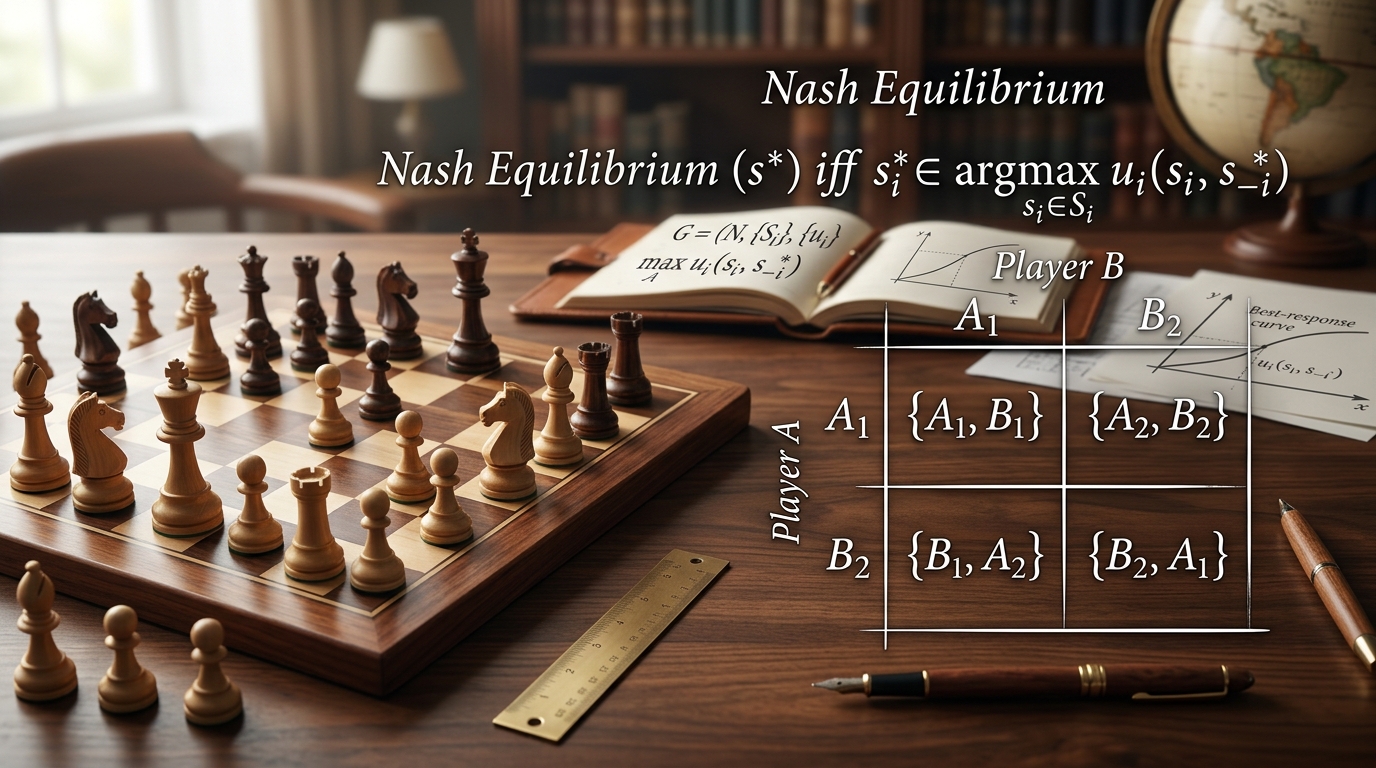
Game Theory is one of the most elegant and practical subfields of microeconomics. It analyzes strategic interactions where the outcome for any single decision-maker depends not only on their own choices, but also on the choices made by competing agents.
For undergraduate students enrolled in Delhi University's B.A. (Hons) Economics or B.A. Programme (Intermediate Microeconomics I & II), Game Theory forms a core 15-mark numerical block in semester examinations.
In this 4,000-word numerical masterclass, we derive the mathematical properties of Normal Form Games, define Dominant and Dominated strategies, derive Pure Strategy Nash Equilibrium (PSNE) and Mixed Strategy Nash Equilibrium (MSNE), link game theory to Cournot-Bertrand oligopoly models, and solve 3 step-by-step examination numerical problems.
1. The Anatomy of a Strategic Game (Normal Form)
A non-cooperative game in Normal Form (or Strategic Form) consists of three fundamental components:
- Players (N): A finite set of decision-makers, indexed by i = 1, 2, ..., n.
- Strategy Space (Si): The set of feasible actions available to player i. A specific strategy profile is denoted s = (s1, s2, ..., sn).
- Payoff Functions (ui): A function ui: S -> Real Numbers that assigns a utility payoff to player i for every strategy profile s.
2. Dominant vs. Dominated Strategies
Before finding a Nash Equilibrium, economists simplify games by identifying strictly dominant or strictly dominated strategies.
2.1 Strictly Dominant Strategy
A strategy s_i* in S_i is strictly dominant for player i if it yields a strictly higher payoff than any other strategy s_i in S_i, regardless of what strategy profile s_-i the opponents choose:
2.2 Strictly Dominated Strategy
Conversely, a strategy s_i is strictly dominated by s_i' if s_i' produces a strictly better payoff than s_i against all opponent actions. Rational players NEVER play strictly dominated strategies.
3. The Prisoner's Dilemma Matrix
The classic Prisoner's Dilemma illustrates why individual rationality can lead to collective inefficiency.
| Player 1 \ Player 2 | Cooperate (C) | Defect (D) |
|---|---|---|
| Cooperate (C) | (3, 3) | (0, 5) |
| Defect (D) | (5, 0) | (1, 1) — Nash Equilibrium |
Key Insight: Defect (D) is a strictly dominant strategy for both players. The unique Nash Equilibrium is (D, D) yielding payoffs (1, 1). However, (C, C) yields (3, 3) which Pareto-dominates (1, 1). This conflict between individual incentive and social Pareto efficiency is the central paradox of non-cooperative game theory.
4. Pure Strategy Nash Equilibrium (PSNE) Definition
A strategy profile s* = (s1*, s2*, ..., sn*) is a Pure Strategy Nash Equilibrium if no player can unilaterally deviate to increase their payoff:
In words: at a Nash Equilibrium, every player is playing a **Best Response** to the strategies chosen by all other players.
5. Mixed Strategy Nash Equilibrium (MSNE)
Not all games possess a Pure Strategy Nash Equilibrium (e.g., Matching Pennies). However, **John Nash's Theorem (1950)** guarantees that every finite game has at least one Nash Equilibrium in pure or mixed strategies.
5.1 The Indifference Principle
In a Mixed Strategy Nash Equilibrium, player 1 chooses a probability distribution p over their pure strategies such that player 2 is made **indifferent** between their own pure strategies, and vice versa.
6. Worked Examination Numerical Problems
Numerical Problem 1: Finding Pure & Mixed Strategy Nash Equilibrium
Question (15 Marks DU Exam Style): Consider the following 2x2 normal form game:
| Player 1 \ Player 2 | Left (L) | Right (R) |
|---|---|---|
| Top (T) | (4, 2) | (0, 0) |
| Bottom (B) | (0, 0) | (2, 4) |
Part (a): Find all Pure Strategy Nash Equilibria.
Part (b): Find the Mixed Strategy Nash Equilibrium.
Solution Part (a): Pure Strategy NE Analysis
We use the Best Response underlining method:
- If Player 2 plays L: Player 1 compares T (payoff 4) vs B (payoff 0). Best response is T.
- If Player 2 plays R: Player 1 compares T (payoff 0) vs B (payoff 2). Best response is B.
- If Player 1 plays T: Player 2 compares L (payoff 2) vs R (payoff 0). Best response is L.
- If Player 1 plays B: Player 2 compares L (payoff 0) vs R (payoff 4). Best response is R.
The strategy profiles where both choices are mutual best responses are:
PSNE 2 = (Bottom, Right) with payoffs (2, 4)
Solution Part (b): Mixed Strategy NE Derivation
Let Player 1 play Top with probability p and Bottom with probability (1 - p).
Let Player 2 play Left with probability q and Right with probability (1 - q).
Step 1: Make Player 2 indifferent between L and R
Expected Payoff to Player 2 from R: E_2(R) = 0*p + 4*(1 - p) = 4 - 4p
Set E_2(L) = E_2(R):
Step 2: Make Player 1 indifferent between T and B
Expected Payoff to Player 1 from B: E_1(B) = 0*q + 2*(1 - q) = 2 - 2q
Set E_1(T) = E_1(B):
Final Answer: The Mixed Strategy Nash Equilibrium is: Player 1 plays (Top: 2/3, Bottom: 1/3) and Player 2 plays (Left: 1/3, Right: 2/3).
Numerical Problem 2: Cournot Duopoly as a Continuous Game
Question: Market demand is P = 100 - Q, where Q = q1 + q2. Two firms have constant marginal cost MC = 10. Find the Cournot Nash Equilibrium quantities and market price.
Solution:
Firm 1 maximizes profit: Profit1 = (100 - q1 - q2)*q1 - 10*q1 = 90*q1 - q1^2 - q1*q2
Take First-Order Condition (FOC) with respect to q1:
By symmetry, Firm 2's Best Response function is:
Solve simultaneously by substituting q2 = q1:
Total Quantity Q* = 60
Market Price P* = 100 - 60 = 40
7. Summary & Exam Checklist
- Check for strictly dominant strategies first to eliminate non-equilibrium rows/columns.
- For MSNE, use the Indifference Principle (Player 1's probability p makes Player 2 indifferent).
- Always show complete step-by-step algebra for 15-mark DU exam numericals.
For related microeconomics proofs, see our Cobb-Douglas Proofs Masterclass and Elasticity of Demand Guide.
Frequently asked questions
What is the difference between a Pure Strategy and a Mixed Strategy Nash Equilibrium?
A Pure Strategy NE occurs when players choose deterministic actions, while a Mixed Strategy NE occurs when players randomize over pure strategies with specific probabilities.
Why is the Prisoner's Dilemma equilibrium Pareto inefficient?
Because both players defecting (1,1) is a Nash Equilibrium, even though mutual cooperation (3,3) would yield higher payoffs for both players.
Dhairya sat the same DU papers he now writes about. Acadly is his attempt to say the useful things his own first-year self would have wanted to hear.
Keep reading
Consumer Theory & Indifference Curves: Utility Maximization, Budget Constraints & Exam Numericals
Comprehensive 4,000-word masterclass on Consumer Theory for DU Economics students. Covers utility functions, indifference curve properties, MRS derivation, budget constraint geometry, Lagrangian optimization, and 3 fully worked numerical problems.
Mundell-Fleming Model: Fixed vs Floating Exchange Rates (Complete Derivations & Policy Efficacy)
Exhaustive 4,500-word masterclass on the Mundell-Fleming open economy macroeconomics model. Includes algebraic derivations of IS*, LM*, BP curves, Marshall-Lerner condition, and India's exchange rate policy.

Cobb-Douglas Production Function: Mathematical Properties, Homogeneity & Returns to Scale Proofs
Exhaustive 4,500-word mathematical masterclass on the Cobb-Douglas production function. Mathematical proofs of Euler's Theorem, constant/increasing returns to scale, marginal productivity, output elasticity, and expansion paths.