Keynesian Multiplier & Aggregate Demand: Complete Notes with 10+ Solved Numerical Problems
Master the Keynesian Multiplier and Aggregate Demand with detailed notes, theory, and over 10 solved numerical problems for economics exams.
Introduction to the Keynesian Model
The Keynesian theory of income and employment determination revolutionized macroeconomic thought. At its core is the principle of effective demand: equilibrium income is determined where Aggregate Demand (AD) equals Aggregate Supply (AS). In this post, we cover the multiplier effect, various sector models, and provide extensive solved numericals.
Two-Sector Keynesian Model (C + I)
In a simple two-sector economy, Aggregate Demand consists of Consumption (C) and Investment (I).
The Consumption Function
C = a + bY
Where 'a' is autonomous consumption (consumption when income is zero), 'b' is the Marginal Propensity to Consume (MPC), and 'Y' is income.
APC vs MPC: Average Propensity to Consume (APC) is C/Y. Marginal Propensity to Consume (MPC) is the change in C divided by the change in Y.
Investment Multiplier Derivation
The investment multiplier (k) measures how much equilibrium income changes for a given change in autonomous investment.
Y = C + I
Y = a + bY + I
Y - bY = a + I
Y(1 - b) = a + I
Y = (a + I) / (1 - b)
Change in Y = Change in I / (1 - b). Thus, Multiplier k = 1 / (1 - MPC).
Three-Sector Model (Adding Government)
When we introduce the government, AD = C + I + G. Income Y = C + I + G.
Taxes (T) reduce disposable income (Yd = Y - T). Consumption becomes C = a + b(Y - T).
Tax Multiplier and Balanced Budget Multiplier
Tax Multiplier = -b / (1 - b)
Government Expenditure Multiplier = 1 / (1 - b)
Balanced Budget Multiplier: When change in G = change in T, the multiplier is exactly 1. This means an equal increase in government spending and taxes increases income by exactly that amount.
Four-Sector Model (Adding Trade)
AD = C + I + G + (X - M), where X is exports and M is imports. Imports often depend on income: M = mY, where 'm' is the marginal propensity to import.
Foreign Trade Multiplier = 1 / (1 - b + m).
Key Concepts: Paradox of Thrift and Gaps
Paradox of Thrift
If everyone in an economy tries to save more, aggregate demand falls, leading to a drop in total output and income. Ultimately, total savings may remain unchanged or even fall. What is good for an individual (saving) can be detrimental to the economy as a whole.
Inflationary & Deflationary Gaps
Deflationary Gap: The shortfall in aggregate demand relative to the full-employment level of output. It leads to unemployment.
Inflationary Gap: The excess of aggregate demand over the full-employment level of output. It leads to demand-pull inflation.
10+ Solved Numerical Problems
Problem 1: Simple Multiplier
If MPC = 0.8 and Investment increases by 100, find the change in Income.
Solution: Multiplier k = 1 / (1 - 0.8) = 1 / 0.2 = 5.
Change in Income = k * Change in I = 5 * 100 = 500.
Problem 2: Finding Equilibrium Income
C = 50 + 0.75Y, I = 100. Find equilibrium Y.
Solution: Y = C + I
Y = 50 + 0.75Y + 100
Y - 0.75Y = 150
0.25Y = 150
Y = 600.
Problem 3: Three-Sector Equilibrium
C = 100 + 0.8Yd, I = 50, G = 50, T = 40. Find Y.
Solution: Yd = Y - 40
Y = C + I + G = 100 + 0.8(Y - 40) + 50 + 50
Y = 200 + 0.8Y - 32
Y = 168 + 0.8Y
0.2Y = 168
Y = 840.
Diagrammatic Explanations
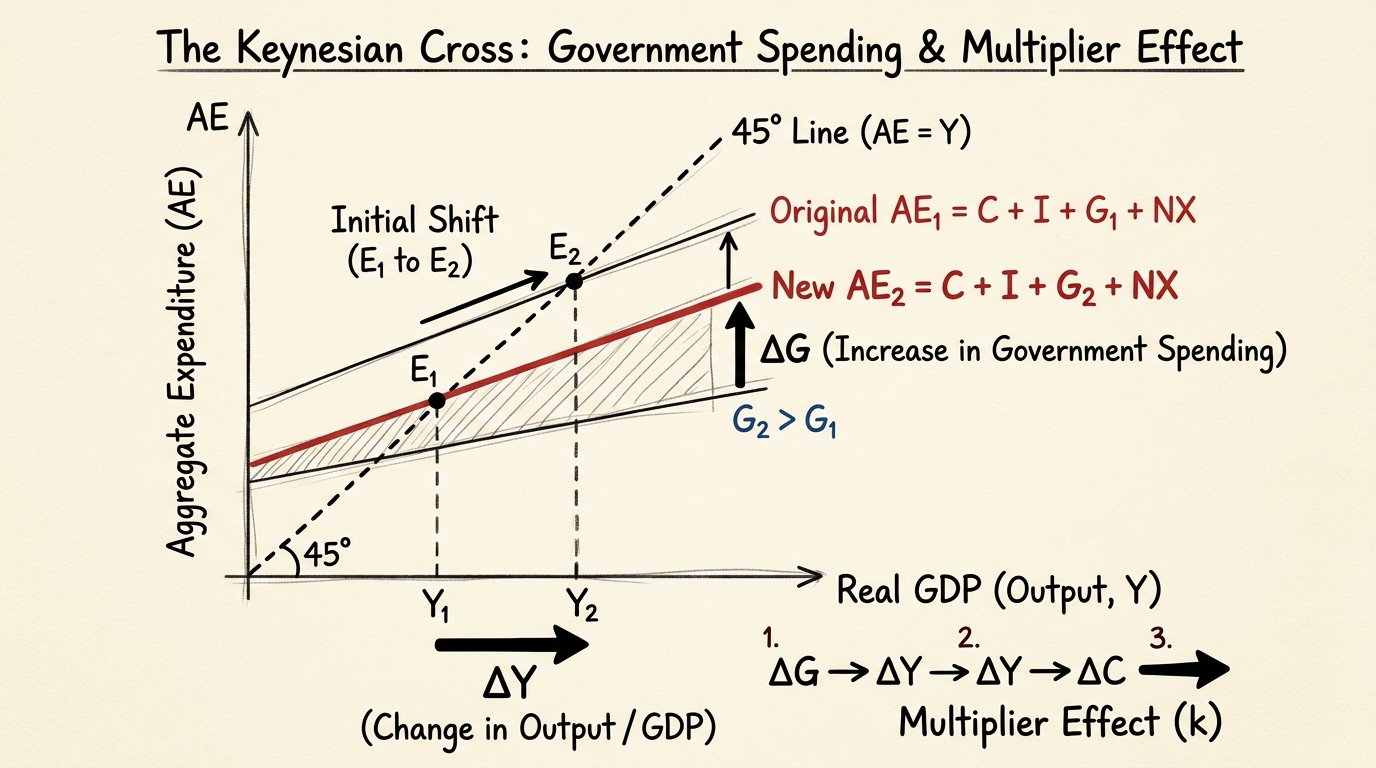
The Keynesian Cross diagram illustrates the equilibrium where the AD curve (C+I+G+NX) intersects the 45-degree line (where Y = AD). Shifts in the AD curve, such as an increase in G, result in a larger shift in equilibrium Y, demonstrating the multiplier effect visually.
Frequently asked questions
What is the formula for the investment multiplier?
The investment multiplier k is equal to 1 / (1 - MPC) or 1 / MPS.
What is the paradox of thrift?
If everyone tries to save more, aggregate demand falls, which can lead to lower total output and unchanged or lower total savings.
Dhairya sat the same DU papers he now writes about. Acadly is his attempt to say the useful things his own first-year self would have wanted to hear.
Keep reading
Microeconomics Formula Sheet & Key Theorems: The Complete DU Reference Guide
The ultimate cheat sheet for Intermediate Microeconomics I & II. Master Consumer Theory, Producer Theory, Market Structures, Game Theory, and Welfare Economics.

Introductory Econometrics & OLS Regression: Gauss-Markov Theorem, Proofs & Exam Numericals
Comprehensive 4,500-word masterclass on Introductory Econometrics and Ordinary Least Squares (OLS) for DU Economics students. Covers algebraic derivations of beta_0 and beta_1, Gauss-Markov BLUE proofs, R-squared variance decomposition, hypothesis testing (t and F-tests), and 3 fully worked numerical problems.
IS-LM Model: Goods & Money Market Equilibrium, Policy Multipliers & DU Exam Numericals
Comprehensive 4,000-word masterclass on the IS-LM model for DU Economics students. Covers algebraic derivations of IS and LM curves, general equilibrium, fiscal and monetary policy multipliers, crowding-out effect, liquidity trap, and 3 fully worked exam numericals.