Fiscal Policy vs Monetary Policy: The 4,500-Word Indian Economy & Macro Blueprint
Master Fiscal Policy vs Monetary Policy for DU exams. IS-LM-BP Mundell-Fleming model, algebraic multiplier proofs, crowding-out mechanics, 2020-2026 RBI repo rate history, FRBM deficit targets, and 2 word-for-word 15-mark model answers.

In undergraduate macroeconomics and Indian economy papers across Delhi University and central universities, questions evaluating the interaction between Fiscal Policy and Monetary Policy carry substantial mark weight. While students can define both independently, external evaluators expect a rigorous understanding of how tax and expenditure decisions made in North Block by the Ministry of Finance and interest rate decisions made by the Reserve Bank of India (RBI) interlock, push, or constrain each other in closed and open economy settings.
1. The Core Separation: Levers, Actors, and Transmission Channels
| Attribute | Fiscal Policy | Monetary Policy |
|---|---|---|
| Primary Authority | Ministry of Finance / Union Parliament & State Governments | Reserve Bank of India (RBI) Monetary Policy Committee (MPC) |
| Primary Tools | Taxation (Income Tax, Corporate Tax, GST) & Public Capex Expenditure | Repo Rate, Reverse Repo, CRR, SLR, Open Market Operations (OMO) |
| Primary Mandate | Economic growth, infrastructure development, social transfer schemes, equity | Flexible Inflation Targeting (4% +/- 2% CPI) & Financial Stability |
| Implementation Lag | Long implementation lag (requires legislative approvals & tender execution). | Short implementation lag (bi-monthly MPC decisions transmitted via bank rate channels). |
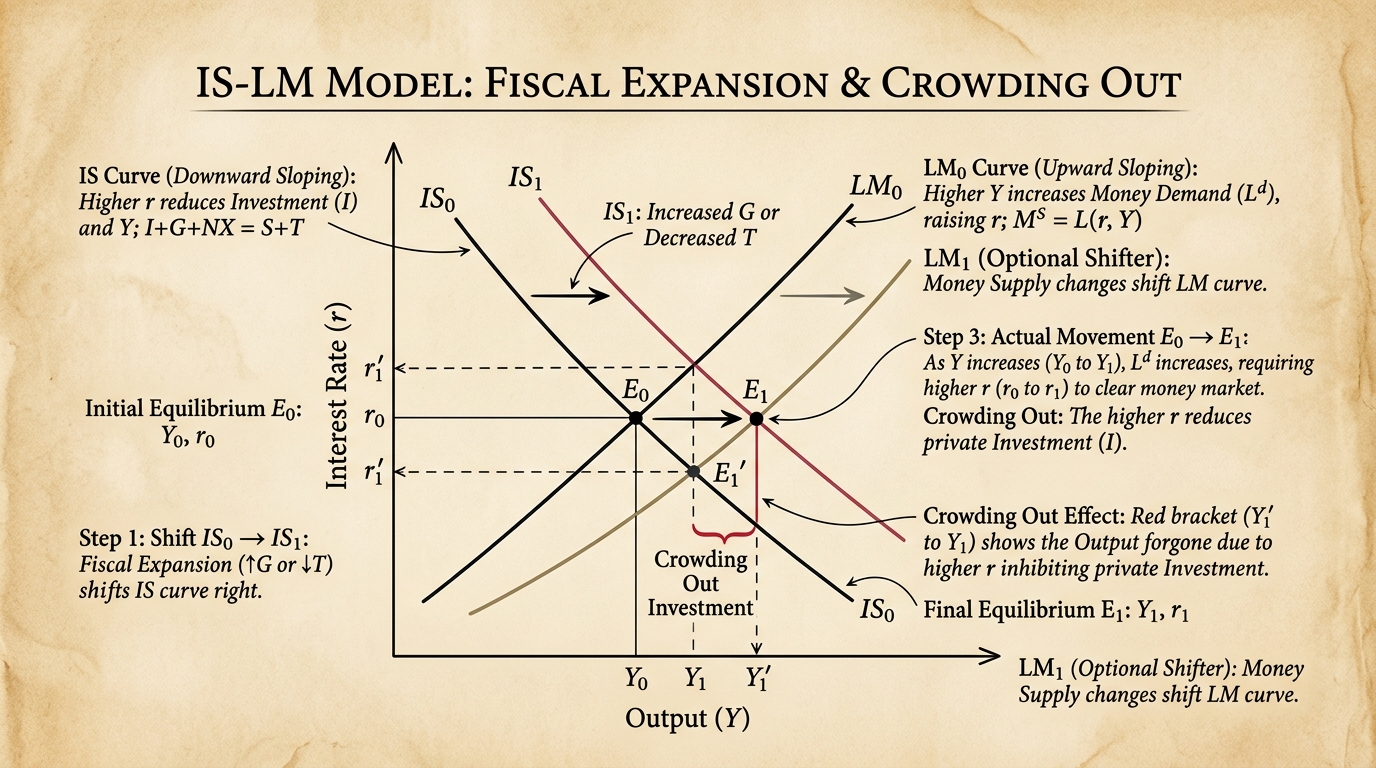
2. Theoretical Mechanics: IS-LM Mathematical Proof & Crowding Out
Consider a closed economy defined by goods market (IS) and money market (LM) equations:
- Goods Market (IS): Y = C(Y - T) + I(r) + G ⟹ Y = c0 + c1(Y - T) + (d0 - d1 r) + G
- Money Market (LM): M/P = L(r, Y) ⟹ M/P = f1 Y - f2 r
Algebraic Multiplier Derivation
Solving for equilibrium output Y as a function of autonomous spending G and real money supply M/P:
Y* = [ 1 / ((1 - c1) + d1(f1 / f2)) ] × [ c0 - c1 T + d0 + G ] + [ (d1 / f2) / ((1 - c1) + d1(f1 / f2)) ] × (M / P)
Crowding-Out Analysis
The fiscal multiplier with interest rate feedback is:
(dY / dG) = 1 / [ (1 - c1) + (d1 × f1 / f2) ] < 1 / (1 - c1) (Simple Keynesian Multiplier)
Economic Meaning: Because f2 (money demand interest sensitivity) is finite, government expenditure increases interest rates (dr/dG > 0), reducing private investment by d1(dr/dG). This difference represents the crowding-out effect.
3. Mundell-Fleming Open Economy Extensions (IS-LM-BP Model)
In an open economy with international capital mobility, the balance of payments (BP) equation is added:
BP = NX(Y, E) + CF(r - r_world) = 0
- Fixed Exchange Rates + Perfect Capital Mobility: Fiscal expansion is maximally effective. When IS shifts right, interest rates rise above r_world, causing massive capital inflows. To maintain fixed exchange rate E, the central bank buys foreign currency, expanding money supply (LM shifts right), eliminating crowding out completely.
- Flexible Exchange Rates + Perfect Capital Mobility: Fiscal expansion is completely ineffective. Capital inflows cause domestic currency appreciation (E ↑), making exports expensive and imports cheap. Net exports drop (NX ↓), shifting the IS curve back to its original position (dY/dG = 0).
4. Empirical Timeline: Indian Macro Policy (2000–2026)
Grounding theoretical IS-LM models in recent Indian macroeconomic statistics published on indiabudget.gov.in and rbi.org.in demonstrates top-band mastery:
- FRBM Act Enactment (2003–2008): Enacted to reduce fiscal deficit to 3.0% of GDP. Reduced fiscal dominance and granted RBI operational independence.
- Global Financial Crisis Stimulus (2008–2010): Fiscal deficit expanded to 6.0% of GDP alongside aggressive RBI repo rate cuts from 9.0% to 4.75%.
- Pandemic Stimulus (2020–2021): Fiscal deficit surged to 9.2% of GDP to fund PM-GKAY food security and capital projects. The RBI slashed repo rate to 4.0%.
- Post-Pandemic Monetary Tightening (2022–2023): RBI MPC executed six consecutive repo rate hikes from 4.0% to 6.5% to combat CPI inflation.
- Fiscal Consolidation Glide Path (2024–2026): Union Budget reduced fiscal deficit from 5.9% to 5.1% and toward 4.5% of GDP under FRBM guardrails.
5. Word-for-Word Exemplar 15-Mark Exam Answer 1
"Critically analyze the crowding-out effect of fiscal expansion using the IS-LM framework. Under what conditions is crowding out complete, and how does central bank monetary accommodation prevent it?" [15 Marks]
1. Definition & Goods/Money Market Setup: Fiscal policy refers to government taxation and expenditure choices aimed at stabilizing aggregate output. In the IS-LM framework, the goods market equilibrium (IS curve) is defined by $Y = C(Y-T) + I(r) + G$, and the money market equilibrium (LM curve) is defined by $M/P = L(r, Y)$.
2. Mechanism of Crowding Out: An increase in government expenditure $\Delta G > 0$ shifts the IS curve rightward from $IS_1$ to $IS_2$. At initial interest rate $r_1$, aggregate demand rises to $Y'$. This higher output increases transactions demand for money. With a fixed real money supply $M/P$, households sell bonds to acquire liquidity, driving bond prices down and interest rates up from $r_1$ to $r_2$. The rise in interest rates reduces private investment spending by $\Delta I = d_1 \Delta r$, resulting in a final equilibrium output $Y_2 < Y'$.
3. Conditions for Complete Crowding Out: Crowding out is complete ($dY/dG = 0$) under two theoretical conditions:
(a) Classical Case (Vertical LM Curve, $f_2 = 0$): When money demand is completely unresponsive to interest rates, any rise in money demand forces interest rates to rise sharply until private investment is crowded out by the exact amount of public spending.
(b) Full Employment Capacity: In a fully employed economy, aggregate supply is vertical. Any fiscal expansion merely bids up prices, leaving real output unchanged.
4. Monetary Accommodation: The RBI can prevent crowding out by executing an expansionary Open Market Operation (OMO) bond purchase. This shifts the LM curve rightward from $LM_1$ to $LM_2$, keeping interest rates pegged at $r_1$ and allowing output to expand fully to $Y'$.
6. Related Macro & Career Guides
To deepen your macroeconomics foundation, explore our explainers on GDP Deflator vs CPI Inflation Metrics, Career Trajectories for Economics Graduates, and Evaluating CAT vs Civil Services vs Master's Degrees.
Frequently asked questions
Which is more effective, fiscal or monetary policy?
Neither is universally better. Monetary policy is faster and more flexible; fiscal policy has more direct effect when interest rates are low and demand is weak.
What is the RBI's inflation target?
4% CPI inflation with a tolerance band of 2% to 6%, set jointly with the Government of India and reviewed periodically.
How does crowding out work?
Higher government borrowing can raise interest rates, which discourages private investment, partially offsetting the fiscal expansion.
Dhairya sat the same DU papers he now writes about. Acadly is his attempt to say the useful things his own first-year self would have wanted to hear.
Keep reading
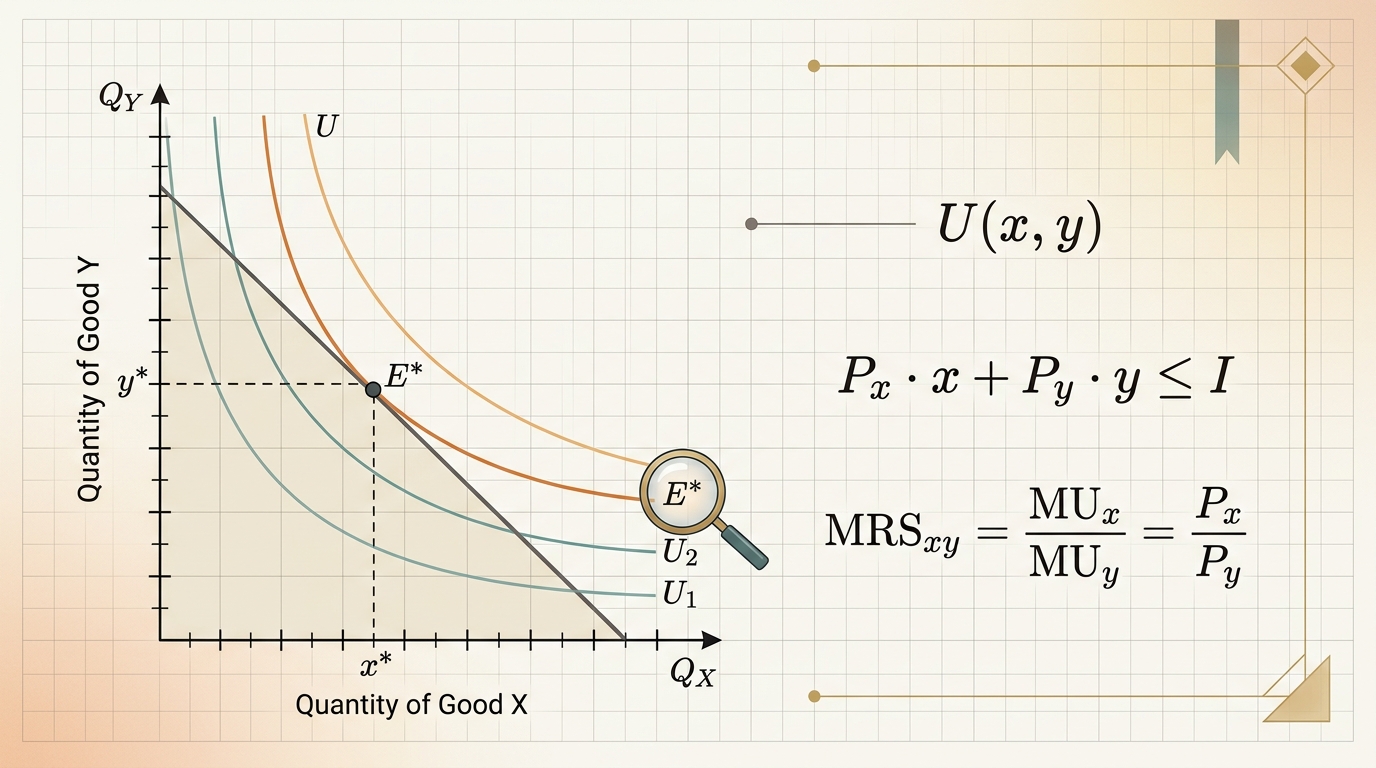
Consumer Theory & Indifference Curves: Utility Maximization, Budget Constraints & Exam Numericals
Comprehensive 4,000-word masterclass on Consumer Theory for DU Economics students. Covers utility functions, indifference curve properties, MRS derivation, budget constraint geometry, Lagrangian optimization, and 3 fully worked numerical problems.

Game Theory & Nash Equilibrium: Mathematical Derivations, Payoff Matrices & Exam Numericals
Comprehensive 4,000-word masterclass on Game Theory and Nash Equilibrium for DU Economics students. Covers dominant strategies, Prisoner's Dilemma, mixed strategies, Cournot duopoly, and 3 fully worked numerical problems.
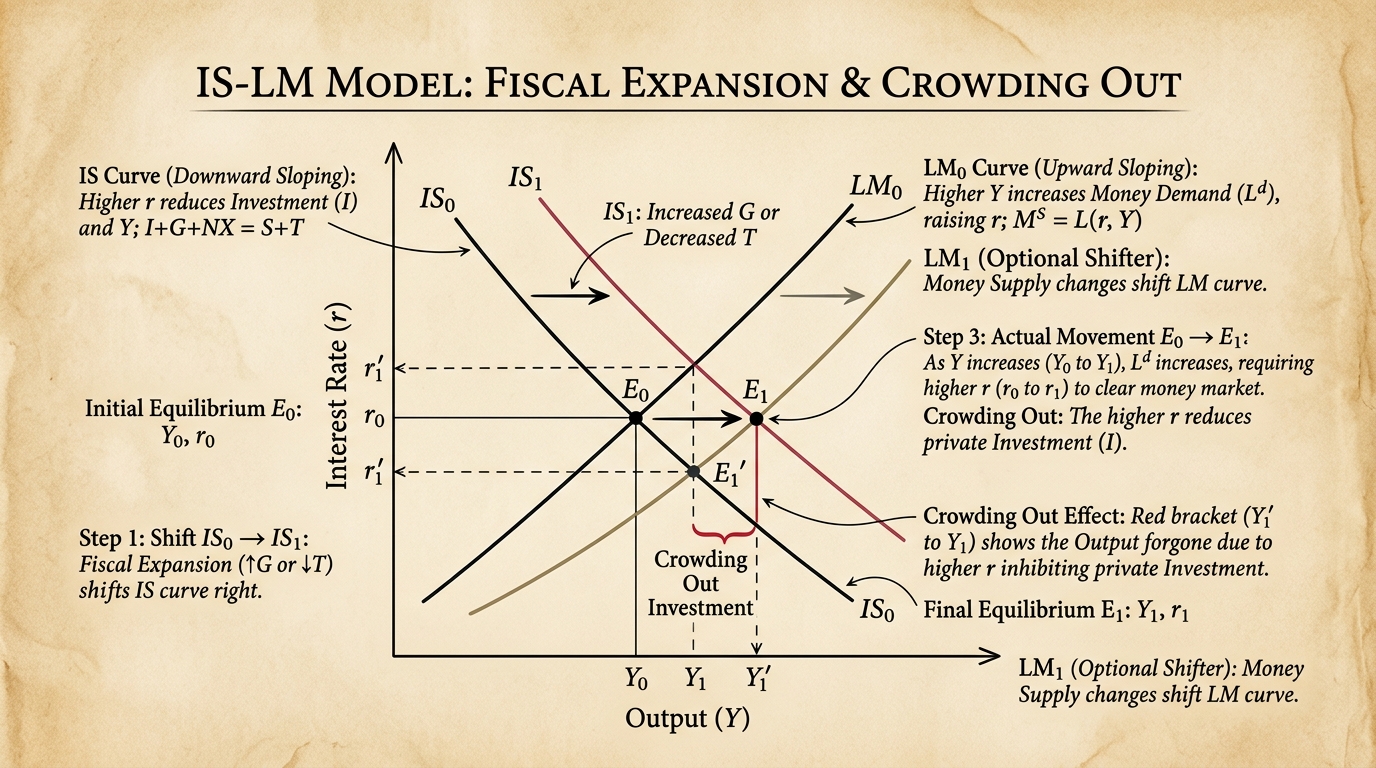
Mundell-Fleming Model: Fixed vs Floating Exchange Rates (Complete Derivations & Policy Efficacy)
Exhaustive 4,500-word masterclass on the Mundell-Fleming open economy macroeconomics model. Includes algebraic derivations of IS*, LM*, BP curves, Marshall-Lerner condition, and India's exchange rate policy.