Demand & Supply Analysis: Market Equilibrium, Shifts, Price Controls & Solved Problems
Comprehensive guide to demand and supply analysis, market equilibrium, shifts in curves, price ceilings, floors, taxation incidence, and 10+ solved numerical problems.
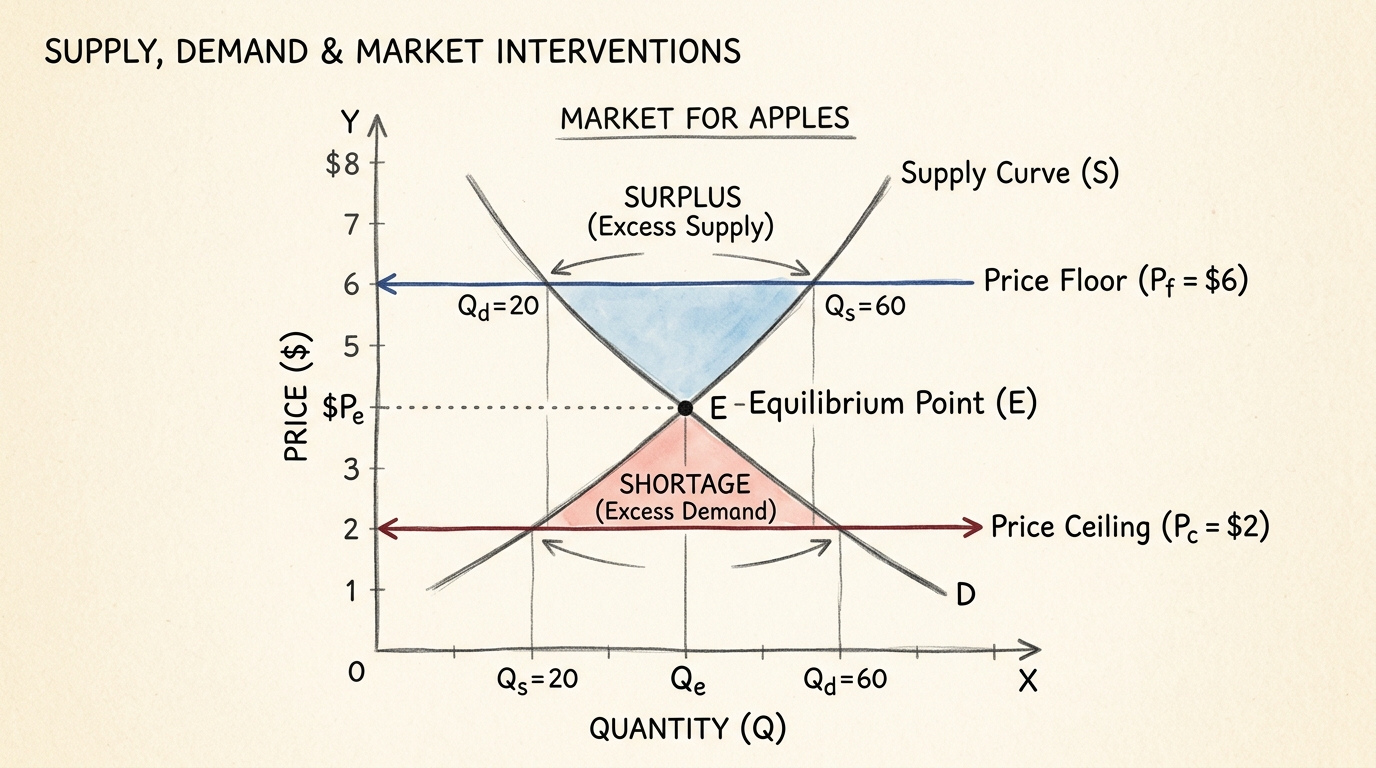
Understanding demand and supply is the foundation of all economic analysis. Whether it is predicting the impact of an MSP announcement for wheat in Punjab or understanding why onion prices skyrocket during certain months, the demand-supply framework is your ultimate toolkit. In this comprehensive guide, we will break down the mechanics of market equilibrium, analyze what happens when curves shift, explore the effects of government interventions like price controls and taxes, and solve over 10 numerical problems typically seen in university exams.
1. The Law of Demand and its Determinants
The Law of Demand states that, ceteris paribus (all other things being equal), there is an inverse relationship between the price of a good and the quantity demanded. If the price goes up, quantity demanded goes down.
Mathematical Representation: Qd = f(P), where dQd/dP < 0.
Exceptions to the Law of Demand
- Giffen Goods: Strongly inferior goods for which the income effect outweighs the substitution effect. When price rises, the consumer is so impoverished that they consume more of this staple (e.g., cheap potatoes during a famine).
- Veblen Goods: Luxury goods that serve as status symbols. A higher price increases their appeal (e.g., designer bags, luxury cars).
Determinants of Demand
While price causes movement along the demand curve, other factors cause the entire curve to shift:
- Income: Normal goods see increased demand with higher income. Inferior goods see decreased demand.
- Prices of Related Goods: Substitutes (tea and coffee) and Complements (cars and petrol).
- Tastes and Preferences: Health trends, fashion.
- Population and Demographics: Larger population means more demand.
- Expectations: If consumers expect prices to rise tomorrow, they buy more today.
2. The Law of Supply and its Determinants
The Law of Supply states that, ceteris paribus, there is a direct relationship between price and quantity supplied. Higher prices incentivize producers to supply more due to higher profit margins.
Mathematical Representation: Qs = f(P), where dQs/dP > 0.
Determinants of Supply
- Input Prices: Cost of raw materials, labor, capital.
- Technology: Improvements increase efficiency and shift supply to the right.
- Government Policy: Taxes decrease supply; subsidies increase supply.
- Number of Sellers: More firms in the market increase total supply.
- Expectations: Expectation of future price changes can alter current supply.
3. Market Equilibrium Determination
Market equilibrium occurs at the price where quantity demanded equals quantity supplied (Qd = Qs). Geometrically, it is the intersection of the downward-sloping demand curve and the upward-sloping supply curve.
At any price above equilibrium, there is a surplus (Qs > Qd), which puts downward pressure on price. At any price below equilibrium, there is a shortage (Qd > Qs), putting upward pressure on price.
Solved Problem 1: Finding Equilibrium
Question: Given Qd = 100 - 2P and Qs = 20 + 3P. Find the equilibrium price and quantity.
Solution:
Set Qd = Qs: 100 - 2P = 20 + 3P
80 = 5P => P = 16
Substitute P back into either equation: Q = 100 - 2(16) = 100 - 32 = 68.
Equilibrium Price = 16, Equilibrium Quantity = 68.
4. Effects of Shifts in Demand & Supply
What happens when the curves shift? There are 9 possible combinations of static, increasing, or decreasing demand and supply.
| Scenario | Demand Change | Supply Change | Effect on Price (P) | Effect on Quantity (Q) |
|---|---|---|---|---|
| 1 | Increase (Right) | No Change | Increases | Increases |
| 2 | Decrease (Left) | No Change | Decreases | Decreases |
| 3 | No Change | Increase (Right) | Decreases | Increases |
| 4 | No Change | Decrease (Left) | Increases | Decreases |
| 5 | Increase | Increase | Ambiguous | Increases |
| 6 | Decrease | Decrease | Ambiguous | Decreases |
| 7 | Increase | Decrease | Increases | Ambiguous |
| 8 | Decrease | Increase | Decreases | Ambiguous |
| 9 | No Change | No Change | No Change | No Change |
Solved Problem 2: Analyzing Shifts
Question: Due to a health craze, demand for oats increases. Simultaneously, a drought destroys the oat harvest. What happens to equilibrium price and quantity?
Solution: Demand shifts right (increases P and Q). Supply shifts left (increases P, decreases Q). Combining these, the price will definitely increase, but the effect on quantity is ambiguous and depends on the relative magnitudes of the shifts.
5. Government Intervention: Price Controls
Price Ceiling
A maximum legally allowable price set by the government, typically to protect consumers. To be binding (effective), it must be set below the equilibrium price.
Effects: Causes a shortage (Qd > Qs). Can lead to non-price rationing mechanisms (queues, favoritism) and black markets.
Indian Example: Rent control in Mumbai; capping prices of essential medicines.
Solved Problem 3: Price Ceiling Shortage
Question: Market for apartments: Qd = 5000 - 4P, Qs = -1000 + 6P. Government sets a rent ceiling of P = 400. Find the shortage.
Solution:
Calculate Equilibrium: 5000 - 4P = -1000 + 6P => 6000 = 10P => P* = 600.
Since ceiling (400) < P* (600), it is binding.
At P = 400:
Qd = 5000 - 4(400) = 3400
Qs = -1000 + 6(400) = 1400
Shortage = Qd - Qs = 3400 - 1400 = 2000 apartments.
Price Floor
A minimum legally allowable price, often to protect producers. To be binding, it must be set above equilibrium.
Effects: Causes a surplus (Qs > Qd). The government often has to purchase the surplus to maintain the price floor.
Indian Example: Minimum Support Price (MSP) for wheat and paddy. The government sets MSP above market-clearing levels to ensure farmer viability, leading to massive FCI stockpiles (surplus).
Solved Problem 4: Minimum Support Price Surplus
Question: Wheat market: Qd = 200 - 5P, Qs = 50 + 10P. Government sets MSP (price floor) at P = 12. Calculate the surplus and government expenditure if it buys the surplus.
Solution:
Equilibrium: 200 - 5P = 50 + 10P => 150 = 15P => P* = 10. Floor (12) is binding.
At P = 12: Qd = 200 - 60 = 140. Qs = 50 + 120 = 170.
Surplus = 170 - 140 = 30 units.
Government cost = Surplus * MSP = 30 * 12 = 360.
6. Taxation Incidence and Subsidy Analysis
Taxation (Specific Tax)
A per-unit tax shifts the supply curve upwards by the amount of the tax (if levied on producers).
Incidence (Who bears the burden?): Depends on relative elasticities.
- If Demand is more inelastic than Supply: Consumers bear a larger share of the tax.
- If Supply is more inelastic than Demand: Producers bear a larger share.
Indian Example: Excise duties on petrol and liquor. Demand is highly inelastic, so the burden is overwhelmingly passed onto the consumer in the form of higher prices.
Solved Problem 5: Tax Incidence
Question: Qd = 100 - P, Qs = P. A tax of t=10 per unit is levied on producers. Find new equilibrium, price paid by consumers (Pc), price received by producers (Pp), and tax revenue.
Solution:
Original Equilibrium: 100 - P = P => P* = 50, Q* = 50.
New Supply curve (incorporating tax t=10): Qs = (P - 10).
New Equilibrium: 100 - P = P - 10 => 110 = 2P => Pc = 55 (Price consumers pay).
Price producers receive: Pp = Pc - t = 55 - 10 = 45.
New Quantity: Q = 100 - 55 = 45.
Consumer Burden = (55 - 50) = 5. Producer Burden = (50 - 45) = 5. (Burden is shared equally since slopes are equal).
Tax Revenue = t * Q = 10 * 45 = 450.
Subsidy Analysis
A subsidy is a negative tax. It shifts the supply curve downwards, lowering the price for consumers and increasing the price received by producers. The benefits are shared based on relative elasticities, similar to taxes.
More Solved Problems for Practice
Problem 6: Shifts and Equations
Original: Qd = 200 - 2P, Qs = 40 + 2P. Demand increases to Qd' = 240 - 2P. Find the change in equilibrium price.
Sol: Old P*: 200-2P = 40+2P => 160=4P => P=40. New P*: 240-2P = 40+2P => 200=4P => P=50. Price increased by 10.
Problem 7: Perfectly Inelastic Supply
Qd = 50 - P, Qs = 20 (perfectly inelastic). Find equilibrium and the effect of a tax of 5 on consumers.
Sol: P*: 50 - P = 20 => P = 30. If tax is on consumers, Qd becomes 50 - (P + 5) = 45 - P. New eq: 45 - P = 20 => P = 25 (producer price). Consumer price = 25 + 5 = 30. Consumers effectively pay the same, producers bear the full burden.
Problem 8: Black Market Price
From Problem 3 (Price Ceiling of 400 causing Q=1400). What is the maximum black market price?
Sol: At Q=1400, what are consumers willing to pay? Plug into demand curve: 1400 = 5000 - 4P => 4P = 3600 => P = 900. Black market price can go up to 900.
Problem 9: Subsidy Incidence
Qd = 120 - P, Qs = P. Subsidy of s=20 per unit given to producers. Find new Pc and Pp.
Sol: Old P=60. New supply: Qs = (P + 20). 120 - P = P + 20 => 100 = 2P => Pc = 50. Pp = Pc + 20 = 70.
Problem 10: Percentage Change in Revenue
Qd = 100 - P, Qs = 20 + P. Due to an ad campaign, Qd becomes 120 - P. Find % change in total revenue (TR=P*Q).
Sol: Old Eq: P=40, Q=60. TR1 = 2400. New Eq: P=50, Q=70. TR2 = 3500. % Change = ((3500 - 2400)/2400)*100 = 45.83%.
Conclusion and Exam Tips
Mastering demand and supply shifts is crucial for any economics exam. Remember the golden rules: draw the graph for every question to avoid silly mistakes, always verify which curve shifts, and check if government controls (ceilings/floors) are actually binding before calculating shortages or surpluses. By practicing the numerical problems above, you will be well-prepared to tackle any question on market equilibrium and government intervention.
Frequently asked questions
What is a binding price ceiling?
A maximum price set below the equilibrium price, leading to a shortage.
Who bears the burden of a tax?
The burden falls more heavily on the side of the market that is less elastic.
Dhairya sat the same DU papers he now writes about. Acadly is his attempt to say the useful things his own first-year self would have wanted to hear.
Keep reading
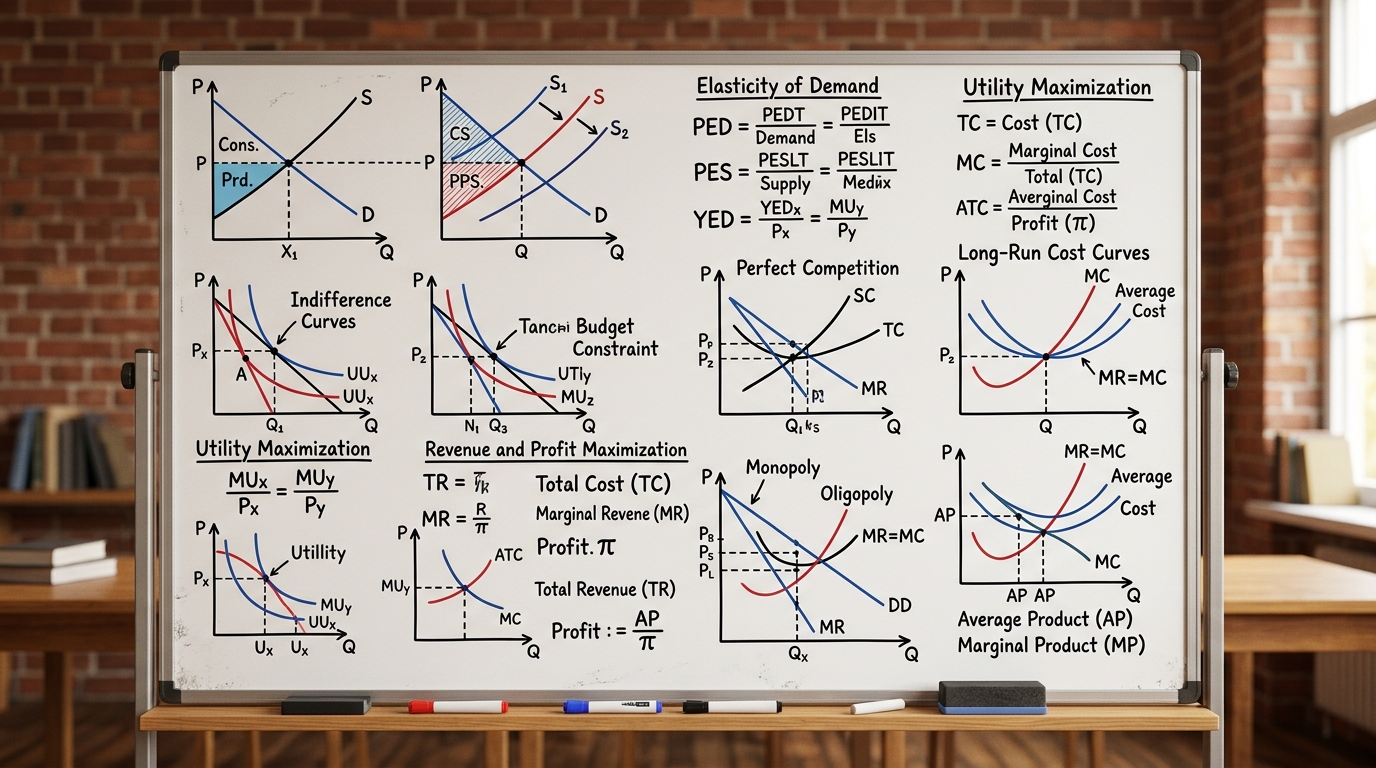
Microeconomics Formula Sheet & Key Theorems: The Complete DU Reference Guide
The ultimate cheat sheet for Intermediate Microeconomics I & II. Master Consumer Theory, Producer Theory, Market Structures, Game Theory, and Welfare Economics.
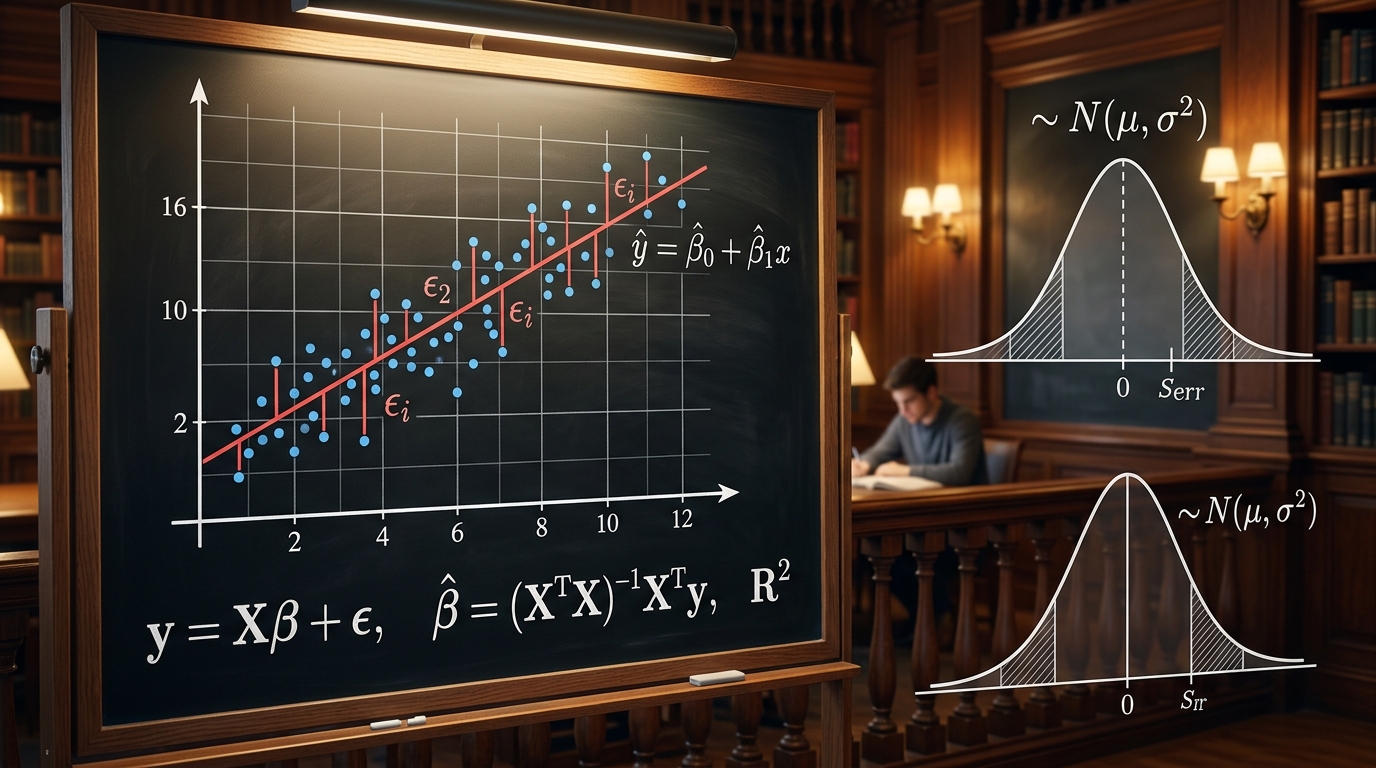
Introductory Econometrics & OLS Regression: Gauss-Markov Theorem, Proofs & Exam Numericals
Comprehensive 4,500-word masterclass on Introductory Econometrics and Ordinary Least Squares (OLS) for DU Economics students. Covers algebraic derivations of beta_0 and beta_1, Gauss-Markov BLUE proofs, R-squared variance decomposition, hypothesis testing (t and F-tests), and 3 fully worked numerical problems.
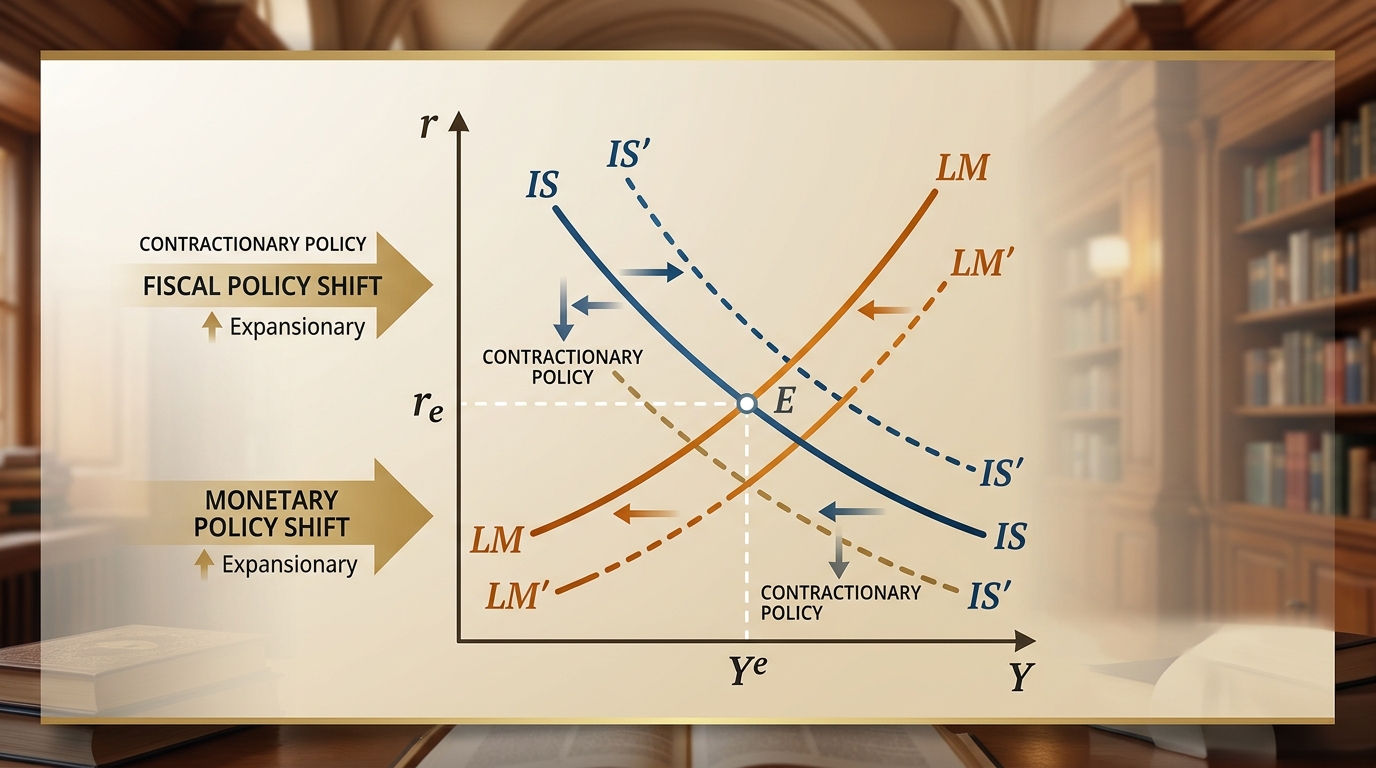
IS-LM Model: Goods & Money Market Equilibrium, Policy Multipliers & DU Exam Numericals
Comprehensive 4,000-word masterclass on the IS-LM model for DU Economics students. Covers algebraic derivations of IS and LM curves, general equilibrium, fiscal and monetary policy multipliers, crowding-out effect, liquidity trap, and 3 fully worked exam numericals.