RBI Grade B DEPR 2026 Preparation: Phase 1 & 2 Syllabus, DSE Course Mapping & Books
Exhaustive 4,000-word preparation guide for RBI Grade B DEPR (Department of Economic and Policy Research) 2026. Phase 1 Objective & Phase 2 Descriptive exam papers, complete syllabus, DSE/DU course mapping, PYQ analysis, book recommendations, and 6-month preparation timeline.
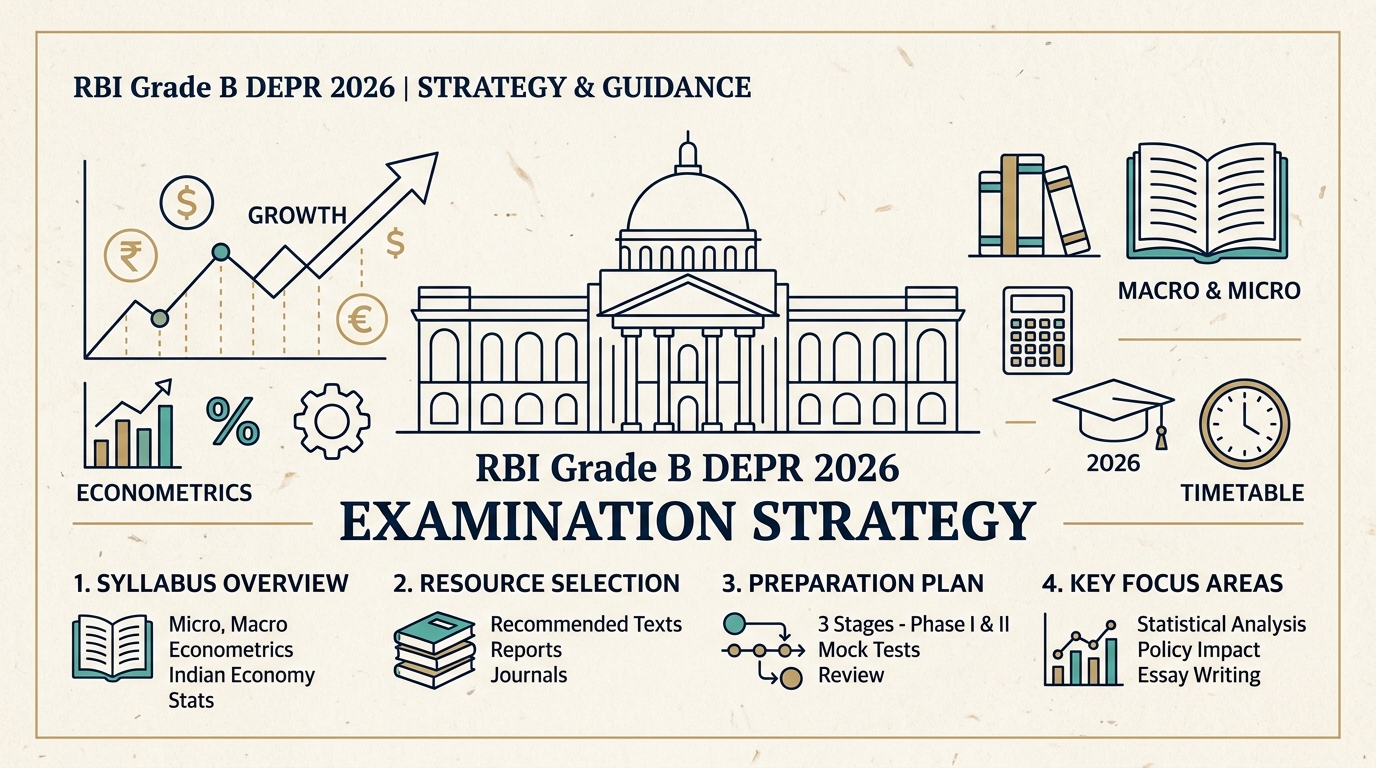
The Reserve Bank of India Grade B (Department of Economic and Policy Research — DEPR) Officer recruitment is the premier public-sector career destination for economics postgraduates. DEPR officers contribute directly to India's monetary policy formulation, publish the annual Report on Currency and Finance, draft working papers on inflation dynamics and GDP forecasting, and assist the RBI Monetary Policy Committee (MPC) in setting the benchmark repo rate. This guide maps every exam component to specific DU and DSE course modules so that economics graduates can build a targeted preparation strategy.
1. Eligibility Criteria
- Educational Qualification: Master's degree in Economics, Finance, or a closely related quantitative discipline from a recognized Indian or foreign university with minimum 55% aggregate marks (50% for SC/ST/PwBD).
- Age Limit: 21 to 30 years as on January 1 of the recruitment year (relaxations apply for SC/ST: +5 years, OBC-NCL: +3 years, PwBD: +10 years).
- Nationality: Indian citizen only.
- Attempt Limits: No restriction on the number of attempts within the age limit window.
Important: Students in the final year of their Master's degree can apply provisionally, provided they submit the degree certificate within 6 months of joining.
2. Complete Exam Pattern & Selection Architecture
| Stage | Paper Title | Format | Max Marks | Duration |
|---|---|---|---|---|
| Phase 1 (Paper I) | Objective Economics | MCQ (62 questions, negative marking -0.25) | 100 | 120 min |
| Phase 1 (Paper II) | English (Descriptive) | Essay, Precis, Comprehension | 100 | 90 min |
| Phase 2 (Paper I) | Economics I (Micro & Macro Theory) | Descriptive (proofs, diagrams, numericals) | 100 | 180 min |
| Phase 2 (Paper II) | Economics II (Indian Economy, Stats & Econometrics) | Descriptive (data analysis, policy essays) | 100 | 180 min |
| Interview | Board Interview | Panel interview (economics + current affairs + personality) | 75 | 20-30 min |
Final Merit: Phase 1 is qualifying only (minimum sectional cutoffs must be cleared). Final merit is calculated as Phase 2 (Paper I + Paper II = 200) + Interview (75) = Total 275 marks.
3. Detailed Syllabus Breakdown
3.1. Phase 1: Objective Economics (100 Marks)
- Micro Theory (20-25 Qs): Demand/supply elasticity, consumer surplus, production functions, cost curves, market structures (perfect competition, monopoly, monopolistic competition, oligopoly), game theory (Nash equilibrium, dominant strategies), welfare economics (Pareto efficiency, social welfare functions).
- Macro Theory (20-25 Qs): National income accounting, IS-LM model, AD-AS framework, Solow growth model, money multiplier, quantity theory of money, Phillips Curve, Mundell-Fleming model, business cycles.
- Indian Economy (10-12 Qs): Five-year plans, 1991 LPG reforms, agricultural policy (MSP, PMKSY), industrial policy, FDI/FPI regulation, GST, RBI monetary policy instruments (repo, CRR, SLR, OMO, LAF), fiscal deficit, current account deficit.
3.2. Phase 2: Paper I — Micro & Macro Theory (100 Marks)
This paper requires writing 5-page descriptive answers with mathematical proofs and fully labelled diagrams. Typical questions include:
- Derive the conditions for Pareto optimality in a 2-consumer, 2-good, 2-factor economy and explain the First and Second Welfare Theorems.
- Using the IS-LM-BP framework, prove that monetary policy is ineffective under a fixed exchange rate regime with perfect capital mobility.
- Derive the steady-state capital-labor ratio in the Solow model and explain the impact of an increase in the savings rate on the transition dynamics.
3.3. Phase 2: Paper II — Indian Economy, Statistics & Econometrics (100 Marks)
- Discuss the evolution of RBI's monetary policy framework from multiple indicator approach to flexible inflation targeting (FIT). Evaluate the effectiveness of FIT in controlling CPI inflation since 2016.
- Explain the OLS assumptions and derive the BLUE properties. What happens to OLS estimators when the assumption of homoscedasticity is violated?
- Analyze the impact of GST implementation on India's indirect tax revenue and tax-to-GDP ratio using data from 2017-2026.
4. Mapping DU & DSE Courses to RBI DEPR Syllabus
| RBI DEPR Topic | DU BA (Hons) Econ Course | DSE MA Economics Course |
|---|---|---|
| Consumer Theory & Welfare | Micro I & II (Sem 1-4) | Micro Analysis I (Sem 1) |
| IS-LM, Solow, Mundell-Fleming | Macro I & II (Sem 3-4) | Macro Analysis I & II (Sem 1-2) |
| Optimization & Lagrangian | MME I & II (Sem 1-2) | Quantitative Methods (Sem 1) |
| OLS & Econometrics | Introductory Econometrics (Sem 5) | Econometrics I & II (Sem 2-3) |
| Indian Economy & Policy | Indian Economic Development (Sem 5-6) | Indian Economy & Policy (Sem 3) |
| Money & Banking | Money & Financial Markets (Sem 5) | Financial Economics (Sem 3-4) |
5. The 6-Month DEPR Preparation Timeline
Complete Varian Micro (Ch. 1-36), Blanchard Macro (Ch. 1-20). Solve 50+ MCQs daily from DEPR PYQ banks. Focus on getting conceptual clarity before speed.
Revise Sydsaeter & Hammond for optimization, Gujarati for OLS/multicollinearity/heteroscedasticity. Practice 10 full-length numerical problems daily.
Read Economic Survey 2025-26 cover-to-cover. Compile RBI Annual Report data on inflation, GDP growth, fiscal deficit, and current account balance. Follow RBI MPC minutes from the last 4 meetings.
Write 2 full-length Phase 2 answers daily (35 minutes each). Practice drawing labelled diagrams (IS-LM, Solow steady-state, Edgeworth box, offer curves). Get peer/mentor feedback on writing structure.
Take 8-10 full-length Phase 1 mocks (timed). Take 4-6 Phase 2 descriptive mocks. Identify weak areas from error logs and do targeted revision. Practice essay writing (500-600 words in 30 minutes) for English paper.
6. Essential Book List
- Microeconomics: Hal Varian, Intermediate Microeconomics (9th Ed.) — primary reference for all micro questions.
- Macroeconomics: Blanchard, Macroeconomics (8th Ed.) + Dornbusch for Mundell-Fleming depth.
- Indian Economy: Ramesh Singh, Indian Economy (latest edition) + Economic Survey 2025-26.
- Econometrics: Damodar Gujarati, Basic Econometrics (5th Ed.) — Chapters 1-13 are critical.
- Money & Banking: Mishkin, Economics of Money, Banking & Financial Markets.
- Mathematical Methods: Sydsaeter & Hammond, Essential Mathematics for Economic Analysis.
- PYQ Papers: RBI Grade B DEPR previous year papers (2018-2025) — available on rbi.org.in careers section.
7. RBI Grade B Officer: Salary, Perks & Career Trajectory
- Starting CTC (2026): Approximately Rs 17-18 LPA (basic pay + grade pay + DA + HRA + other allowances).
- Housing: RBI-provided housing in Mumbai, Delhi, Chennai, or Kolkata (depending on posting) OR HRA equivalent.
- Medical: Full family medical coverage through RBI's medical scheme.
- Promotion Track: Grade B (4-5 years) to Grade C (Assistant General Manager) to Grade D (Deputy General Manager) to Grade E (General Manager) to Grade F (Chief General Manager).
- International Postings: DEPR officers can be deputed to IMF, World Bank, BIS, or RBI's overseas offices (London, New York, Washington DC).
8. Related Career Guides
Frequently asked questions
Is an MA in Economics compulsory for RBI Grade B DEPR?
Yes, a Master's degree in Economics or Quantitative Finance is required.
Dhairya sat the same DU papers he now writes about. Acadly is his attempt to say the useful things his own first-year self would have wanted to hear.
Keep reading

DU Foreign Language Courses 2026: Certificate & Diploma Admissions, Fees & Scope
Exhaustive 4,000-word guide on Delhi University foreign language courses in 2026. Covers Certificate, Diploma, and Advanced Diploma admissions at St. Stephen's, Hansraj, and GRS department, fees, and career scope.
IGIDR Mumbai vs DSE: The Ultimate MA Economics 2026 Comparison Guide
Exhaustive deep-dive comparing IGIDR Mumbai and Delhi School of Economics (DSE) for MA Economics in 2026. Covers curriculum, placements, PhD prospects, campus life, and preparation strategies.
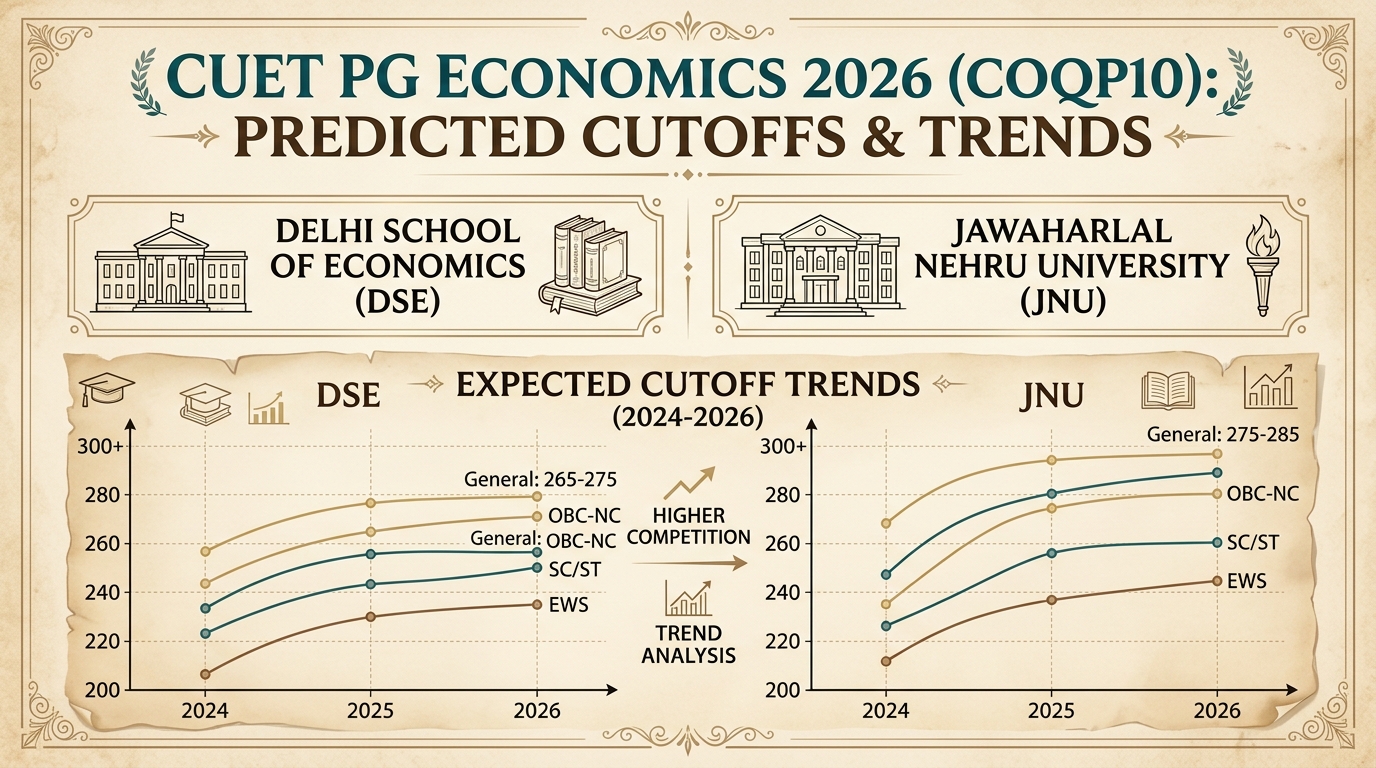
CUET PG Economics 2026 Cutoff Breakdown: DSE (245+), JNU Deprivation Points & Category Ranks
Exhaustive 4,000-word analysis of CUET PG Economics (COQP10) 2026 cutoffs. DSE Delhi raw score thresholds (245+ UR), JNU CESP/CITD deprivation point calculations, complete syllabus breakdown, topic-wise weightage analysis, and 12-week PYQ solving plan.