DU CSAS Round 3 & Spot Admission 2026: Vacant Seats, Tie-Breaking Rules & Registration Masterclass
Complete 4,000-word guide to Delhi University CSAS UG 2026 Round 3 and Spot Allocation. Vacant seat matrix analysis, tie-breaking criteria, upgrade vs freeze decision flowchart, document verification checklist, and CSAS portal registration steps.
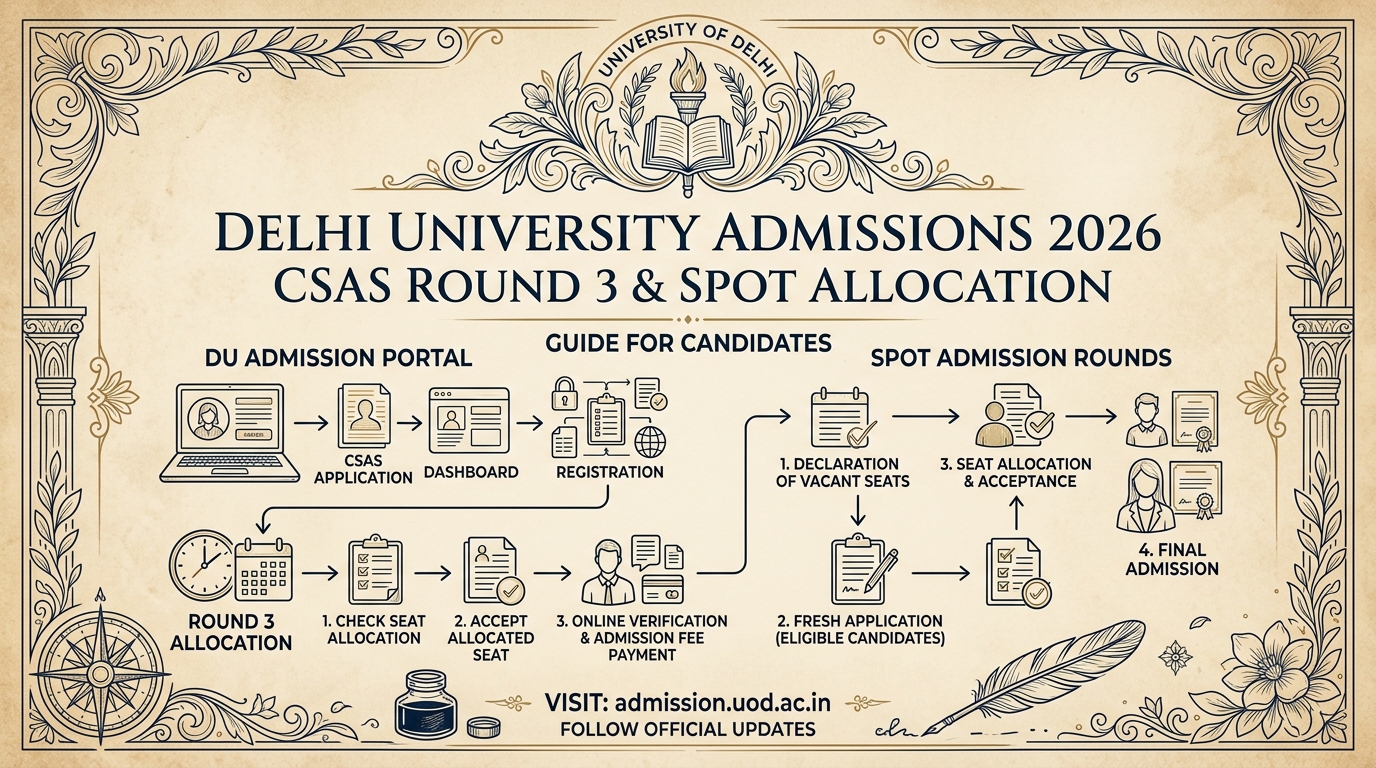
Delhi University is entering the decisive phase of its Common Seat Allocation System for Undergraduate Admissions (CSAS UG 2026). Following the completion of Round 1 and Round 2 fee payment windows on the official portal at admission.uod.ac.in, thousands of applicants are tracking the release of the Round 3 allotment schedule and subsequent Spot Allocation rounds. This guide covers every operational detail you need — from reading the vacant seat matrix to making the final Freeze-vs-Upgrade call.
1. Complete CSAS 2026 Allocation Timeline (All Rounds)
The entire CSAS UG admission cycle follows a structured multi-round pattern. Each round publishes an allotment list, opens an acceptance window, conducts college-level document verification, and collects online fees before moving to the next round. Below is the authoritative timeline as published by the University of Delhi admissions team:
| Milestone | Round 1 | Round 2 | Round 3 | Spot Round |
|---|---|---|---|---|
| Allotment Published | July 18, 2026 | July 25, 2026 | August 1, 2026 (Expected) | August 8–10, 2026 (Expected) |
| Accept/Upgrade Deadline | July 20, 2026 (11:59 PM) | July 27, 2026 (11:59 PM) | August 3, 2026 (Expected) | Within 24 hours of allotment |
| College Verification | July 21, 2026 (5:00 PM) | July 28, 2026 (5:00 PM) | August 4, 2026 (Expected) | Same day as acceptance |
| Fee Payment Closes | July 22, 2026 (11:59 PM) | July 29, 2026 (11:59 PM) | August 5, 2026 (Expected) | Within 48 hours of allotment |
Note: Round 3 and Spot Round dates are indicative projections based on the cadence established by Rounds 1 and 2. Verify exact dates on your CSAS candidate dashboard at admission.uod.ac.in.
2. How to Read the Vacant Seat Matrix
After each round's fee payment window closes, the University of Delhi reconciles accepted and declined seats and publishes a Vacant Seat Matrix. This matrix shows the number of unfilled seats in every college-course-category combination. Understanding this matrix is critical for making strategic Round 3 and Spot Round decisions.
2.1. Matrix Structure
The matrix is published as a downloadable PDF and online searchable table on the CSAS UG portal. It is organized as follows:
- Rows: Each row represents a unique College + Programme combination (e.g., "Hindu College — B.A. (Hons.) Economics").
- Columns: Each column represents a reservation category (Unreserved / OBC-NCL / SC / ST / EWS / PwBD / Kashmiri Migrant / Defence Personnel).
- Cell Values: The number in each cell is the count of vacant seats available for that specific college-programme-category triple.
2.2. Strategic Reading Tips
- Zero Vacancies: If a cell shows "0", that combination is fully occupied. Do not list it as a preference unless you are banking on a withdrawal creating an opening.
- High Vacancy Counts: Colleges and programmes showing 5 or more vacancies in your category are strong candidates for realistic allotment. Prioritize these in your preference reordering.
- Category-Specific Vacancies: Sometimes UR seats are full but OBC-NCL or EWS seats remain. Ensure you are reading the column specific to your reservation category.
- South Campus vs North Campus: South Campus colleges (SRCC, LSR, Jesus and Mary, Gargi) often have different vacancy patterns than North Campus colleges (Hindu, Hansraj, Kirori Mal, Ramjas, Miranda House). Check both clusters.
3. CSAS Round 3 vs. Spot Round: Complete Comparison
| Feature | CSAS Round 3 (Regular Allocation) | Spot Allocation Round |
|---|---|---|
| Who Can Participate | Candidates with active "Upgrade" status from Round 2 + candidates who were unallotted in all previous rounds but remain registered. | Only candidates who do NOT hold any seat from Rounds 1, 2, or 3 (including those who withdrew or were never allotted). |
| Seat Retention Guarantee | Yes. If you chose "Upgrade" in Round 2, your current seat is retained if no higher preference clears in Round 3. | No prior seat exists. You are allocated fresh from the vacant seat pool. |
| Preference Reordering | Allowed. You may reorder your unfilled higher preferences before Round 3 processing begins. | Fresh preference list required based entirely on remaining vacant seat matrix. |
| Acceptance Timeline | Standard 48-hour acceptance window followed by college verification and fee payment. | Compressed timeline: typically 24 hours for acceptance and same-day physical document verification at the allotted college. |
| Further Upgrade Possible? | Yes, if additional rounds are announced after Round 3. | No. Spot Round is final. Once accepted, your admission is locked. |
4. The Upgrade vs. Freeze vs. Withdraw Decision Framework
This is the single most consequential decision of the CSAS process. Making the wrong choice can either lock you into a lower-preference college permanently (Freeze too early) or risk losing a perfectly good seat (Withdraw recklessly). Here is a systematic decision framework:
When to Choose: You have been allotted your top-1 or top-2 preference. OR you have been allotted a seat at a college you are genuinely happy attending regardless of what might be available in later rounds.
What Happens: Your seat is permanently secured. You are removed from the allocation pool for all subsequent rounds. Your fee is non-refundable (except under exceptional withdrawal rules published by DU).
Risk: Zero. You have a confirmed seat.
When to Choose: You are reasonably satisfied with your current allotment but believe higher preferences may open up in Round 3 (based on the vacant seat matrix). You want to keep your current seat as insurance while trying for something better.
What Happens: Your current seat is held. In Round 3, the system checks whether any of your unfilled higher preferences can be allocated. If yes, you are automatically upgraded and your previous seat is released back into the pool. If no higher preference clears, you keep your current seat exactly as before.
Risk: Very low. Upgrading never takes away your current seat — it can only improve or maintain your position.
When to Choose: You have secured admission at another university (JNU, JMI, BHU, state university) or decided not to attend DU at all.
What Happens: Your seat is released. You receive a partial fee refund per DU refund rules. You are permanently removed from CSAS 2026.
Risk: Complete and irreversible. You cannot re-enter the CSAS process once you withdraw.
5. Official DU Tie-Breaking Rules for Equal CUET Scores
When two or more candidates possess identical CUET UG normalized scores for a college-course combination, DU applies the following official tie-breaker hierarchy in strict sequential order:
- Rule 1 — Higher Percentage in Class 12 (Best 3 Subjects): The candidate with a higher aggregate percentage in their best 3 Class 12 subjects is ranked higher. This includes the subject relevant to the programme being applied for.
- Rule 2 — Higher Percentage in Class 12 (Best 4 Subjects): If Best 3 percentages are also identical, the system expands to Best 4 subjects.
- Rule 3 — Higher Percentage in Class 12 (Best 5 Subjects): If Best 4 percentages are still identical, the system expands to Best 5 subjects.
- Rule 4 — Earlier Date of Birth (Older Candidate): If all academic percentages remain identical, the older candidate (earlier date of birth) is given priority.
Practical Implication: Candidates with strong, uniformly high Class 12 scores across multiple subjects have an advantage in tie-breaking situations. This is particularly relevant for competitive programmes at Hindu College, SRCC, and Miranda House where CUET score clusters are dense.
6. Complete Document Verification Checklist
After accepting your allotted seat online, you must physically visit (or submit digitally, depending on college policy) the following documents for verification within the prescribed timeline:
- Class 10 Marksheet & Passing Certificate (Proof of Date of Birth)
- Class 12 Marksheet & Passing Certificate
- Class 12 Migration Certificate (issued by the Board of Education)
- CUET UG 2026 Scorecard (downloaded from the NTA portal at cuet.nta.nic.in)
- CUET UG 2026 Admit Card
- Government-issued Photo ID (Aadhaar Card / Passport / Voter ID)
- 4 recent passport-size colour photographs (white background)
- Character Certificate from the last attended institution
- Anti-Ragging Undertaking (signed by candidate and parent/guardian, available on the CSAS portal)
- SC / ST: Caste Certificate issued by a competent authority (SDM / Tehsildar / DC) — must be issued after March 31, 2026.
- OBC-NCL: OBC Non-Creamy Layer Certificate issued after March 31, 2026, explicitly mentioning the Central Government list of OBCs.
- EWS: Income and Asset Certificate issued by a competent authority (SDM / Tehsildar / DC) for the financial year 2025-26.
- PwBD: Disability Certificate (40% or more) issued by a Designated Medical Board.
- Defence: Serving / Ex-Servicemen Certificate with Priority Category endorsement.
- Kashmiri Migrant: Certificate from the Relief and Rehabilitation Commissioner, Government of NCT of Delhi.
7. Approximate Fee Structure (2026-27 Session)
DU fees vary by college, programme, and category. Below is an indicative range for common programmes:
| Programme Type | UR / OBC / EWS Annual Fee Range | SC / ST Annual Fee Range |
|---|---|---|
| B.A. (Hons.) Arts & Social Sciences | Rs 15,000 to Rs 25,000 | Rs 5,000 to Rs 10,000 (with fee concession) |
| B.Com. (Hons.) | Rs 18,000 to Rs 30,000 | Rs 6,000 to Rs 12,000 (with fee concession) |
| B.Sc. (Hons.) Sciences | Rs 20,000 to Rs 35,000 | Rs 7,000 to Rs 14,000 (with fee concession) |
8. Seven Common Mistakes Students Make During CSAS Rounds
The acceptance window is 48 hours for regular rounds and 24 hours for Spot Rounds. Missing this window by even a minute results in automatic cancellation of your allotment. Set multiple phone alarms.
Students in Round 1 often panic-freeze on a lower preference, fearing they will lose their seat. Remember: choosing "Upgrade" retains your seat with zero risk of losing it. Only Freeze when you have your top choice.
Some students upgrade blindly without checking whether their higher-preference college-programme combination actually has vacancies. Always read the vacant seat matrix before choosing Upgrade.
OBC-NCL and EWS certificates must be issued after March 31, 2026. Certificates from the previous financial year are invalid and will cause verification rejection. Get fresh certificates well before the deadline.
This is a mandatory document. Download it from the CSAS portal, print it, get it signed by both the candidate and parent/guardian, and bring it to college verification.
Accepting the seat online is NOT the final step. You must also complete the online fee payment within the prescribed window. Failure to pay fees results in automatic seat cancellation.
Students from boards outside Delhi (CBSE outside Delhi, ICSE, State Boards) need a Migration Certificate from their board. Apply for it immediately after your Class 12 results are declared — it can take 2-4 weeks to arrive.
9. DU Fee Refund Policy for Withdrawals
Students who withdraw after paying fees are entitled to a partial refund as per UGC guidelines adopted by DU:
- Before Commencement of Classes: Full tuition fee refund minus Rs 1,000 processing charge.
- Within 15 Days of Commencement: Refund of tuition fee after deducting a proportionate amount (typically 10-15%).
- After 15 Days of Commencement: No refund of tuition fees. Only refundable security deposit (if applicable) is returned.
10. Related Admission & Academic Guides
Before finalizing your seat selection, explore these essential companion guides:
- DU CSAS Round 2 Allotment 2026: Deadlines & Rules
- DU Honours vs BA Programme Differences
- DU Grading and Attendance Rules
- DU Elective Selection 2026: GE, SEC & VAC Strategy
- How to Calculate SGPA to CGPA in DU 2026
All admission dates, cutoff lists, vacant seat matrices, and fee payment windows must be verified directly on your CSAS candidate dashboard at admission.uod.ac.in. Acadly aggregates information for educational guidance only; we do not handle DU admissions directly.
Frequently asked questions
When will DU CSAS Round 3 vacant seats be published?
Immediately following the reconciliation of Round 2 online fee payments on admission.uod.ac.in.
Can I upgrade my seat during Spot Allocation?
No, candidates accepting a seat in Spot Allocation cannot upgrade in subsequent regular rounds.
Dhairya sat the same DU papers he now writes about. Acadly is his attempt to say the useful things his own first-year self would have wanted to hear.
Keep reading
DU Mid-Entry & Performance-Based Admission 2026: Registration, Eligibility & Seat Allotment Guide
Complete guide to Delhi University Mid-Entry registration (Aug 3-5, 2026) and Performance-Based UG program allotment. Covers eligibility, correction window, vacant seat strategy, and document verification.
DU Aditi Mahavidyalaya & Bhagini Nivedita Offline Merit Admission 2026: Eligibility, Dates & Process
Delhi University grants one-time offline merit-based admission to Aditi Mahavidyalaya and Bhagini Nivedita College for 2026. Complete guide covering eligibility, application deadline, document verification, and fee payment.
DU NCWEB Admission 2026: 2nd Cutoff Schedule, Seat Matrix & Class 12 Marks Calculator
Comprehensive 4,000-word guide on Delhi University NCWEB admissions 2026. Covers cutoff schedules, Class 12 merit calculation, center selection, fee structure, and NCWEB vs Regular college comparison.