DU First Year Book List 2026: Where to Buy, What to Skip & Digital Resources for Every Course
Comprehensive 4,000-word guide on buying books for your first year at Delhi University in 2026. Course-wise essential readings, cheapest bookshops, free e-resources, and what you should never waste money on.
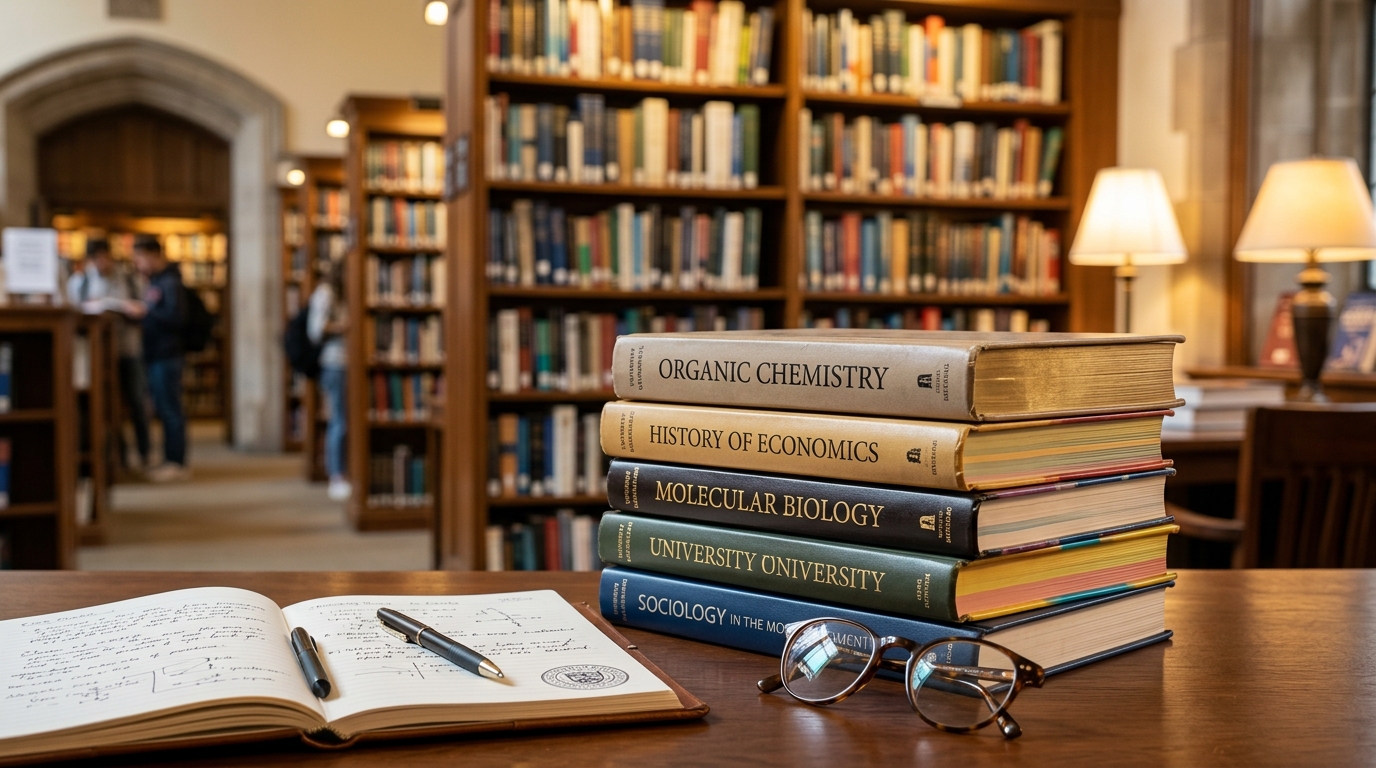
Your first week at Delhi University is a whirlwind of orientations, society pitches, and the slow dawning realization that you actually need to study. The single most common question every fresher asks within 48 hours of their first lecture is: "Which books do I buy?"
The answer is more nuanced than any senior's WhatsApp forward can capture. In this 4,000-word tactical guide, we break down the essential vs. optional readings for major DU courses under UGCF 2022, reveal the cheapest physical bookshops around North and South Campus, introduce the free digital resources most students never discover, and—crucially—tell you what NOT to waste your money on.
1. The Golden Rule: Don't Buy Everything on Day One
This is the single most important piece of advice you will receive. Every year, thousands of freshers panic-buy stacks of textbooks in the first week, only to discover that:
- Their professor uses a completely different textbook than the one listed in the syllabus.
- Half the readings are available for free in the college library or as e-books.
- Xerox copies of specific chapters are far more practical (and cheaper) than owning the entire book.
Attend your first two weeks of lectures before purchasing any textbook. By the end of Week 2, your professors will have explicitly stated which books are essential, which chapters matter, and which references are optional. This alone will save you ₹2,000 to ₹5,000.
2. Course-Wise Essential Readings (UGCF 2022)
Under the Undergraduate Curriculum Framework 2022, your Semester 1 typically includes 3 Discipline-Specific Core (DSC) papers, 1 Generic Elective (GE), 1 Skill Enhancement Course (SEC), 1 Value Addition Course (VAC), and 1 Ability Enhancement Course (AEC). Below, we cover the most popular streams.
2.1 B.A. (Hons) Economics — Semester 1
| Paper | Essential Book(s) | Author | Buy or Borrow? |
|---|---|---|---|
| DSC-1: Introductory Microeconomics | Microeconomics (latest edition) | Hal Varian | BUY — You will use this for 3 semesters. |
| DSC-2: Mathematical Methods I | Fundamental Methods of Mathematical Economics | Alpha C. Chiang | BUY — Core reference for MME I and II. |
| DSC-3: Introductory Statistics | Statistics for Economics | NCERT Class 11 | BORROW — You likely already own this from school. |
Pro Tip: For a deep understanding of the MME syllabus and how to score well, read our MME Distinction Masterclass.
2.2 B.Com (Hons) — Semester 1
| Paper | Essential Book(s) | Author | Buy or Borrow? |
|---|---|---|---|
| Financial Accounting I | Financial Accounting | T.S. Grewal (or college-recommended) | BUY — Foundation for all accounting papers. |
| Business Organisation | Business Organisation and Management | C.B. Gupta | BORROW — Theory-heavy; class notes are sufficient. |
| Business Statistics | Statistics for Business and Economics | S.P. Gupta | BUY — Numerical-heavy; you need practice problems. |
2.3 B.A. (Hons) English — Semester 1
English Honours is unique because you need multiple literary texts (novels, poetry anthologies, plays) rather than single comprehensive textbooks.
- Essential Purchases: The primary texts prescribed for your college (e.g., a Shakespeare play, a novel by a postcolonial author). These are non-negotiable because you need to annotate and reference them in exams.
- What to Skip: Critical companions and secondary reading anthologies. Your professor will share photocopied extracts of the relevant critical essays. Do NOT buy entire Norton Anthologies unless specifically asked.
2.4 B.A. Programme — Semester 1
BA Programme students take papers from two chosen discipline groups plus the common Ability Enhancement and Value Addition courses. The book requirements are lighter per subject since each subject is studied at a less intensive level than Honours.
- Strategy: Rely heavily on NCERT books for foundational subjects (History, Political Science, Sociology). For GE papers, class notes and xeroxed chapters are usually sufficient.
3. Where to Buy: The Cheapest Bookshops in DU
Knowing where to shop is as important as knowing what to buy. The areas surrounding DU campuses have an established ecosystem of bookshops catering specifically to students.
3.1 North Campus Bookshop Guide
The epicentre of DU book shopping. Shops here stock course-specific books, previous year question papers (PYQs), and Shiv Das guides. You can also get specific chapters xeroxed for ₹2-₹3 per page. Haggle—prices are not always fixed.
Home to shops like Selection Book Service and Bookland. Slightly higher prices than Patel Chest but better stock of imported/international editions.
Many colleges (SRCC, Hindu, LSR, Hansraj) have small bookshops or stalls on campus. Convenient but typically carry only the most popular titles at MRP.
3.2 South Campus Bookshop Guide
Students in South Campus colleges (Sri Venkateswara, Jesus & Mary, Deshbandhu) should check the shops around Satya Niketan and Benito Juarez Marg. The selection is smaller but usually adequate for core textbooks.
3.3 Second-Hand Books
This is the secret weapon of budget-conscious students. At the start of every academic year, outgoing seniors sell their books at 40-60% of the original price.
- Facebook Groups: Join groups like "DU Books Buy & Sell" and "North Campus Books Exchange" on Facebook. Seniors post listings in late July and August.
- Daryaganj Sunday Book Market: A legendary open-air book market operating every Sunday. You can find academic books at ₹50-₹150 if you are willing to dig through the stalls.
4. Free Digital Resources Every DU Student Must Know
The Delhi University Library System (DULS) provides access to a treasure trove of e-resources that most students never discover.
4.1 DULS E-Resources
- JSTOR: Access thousands of academic journal articles for free using your DU library credentials.
- EBSCO Host: Another database of full-text academic journals and e-books.
- National Digital Library (NDL): A Government of India initiative providing free access to millions of academic resources across disciplines.
- SWAYAM/NPTEL: Free online courses from IIT and IISc professors that complement your DU syllabus perfectly.
4.2 SOL Study Materials
Even if you are a regular college student, the Self-Learning Materials (SLMs) published by the DU School of Open Learning are freely downloadable from web.sol.du.ac.in. These SLMs are condensed, exam-focused summaries of the same syllabus you study, making them excellent revision tools.
5. What You Should NEVER Waste Money On
Let's be blunt about the purchases that drain your wallet without adding academic value:
- Multiple editions of the same textbook: Varian's 8th edition and 9th edition cover essentially the same content for Introductory Microeconomics. Buy whichever is cheaper.
- Full-price reference books: If a book is only needed for one chapter, xerox that chapter. A single chapter costs ₹20-₹30 vs. ₹800 for the entire book.
- Coaching institute materials for college exams: These are designed for competitive exams (UPSC, CUET), not DU semester exams. Your professors set the papers; their class notes are your best preparation material.
- Solution guides before attempting problems yourself: Shiv Das guides are useful for PYQ practice during revision, not as substitutes for understanding concepts.
6. The Previous Year Question Paper (PYQ) Strategy
PYQs are the single most powerful exam preparation tool in DU. Every bookshop around campus sells compiled PYQ booklets for ₹80-₹150 per subject.
- When to buy: Not in the first week. Buy them in October/November when revision begins.
- How to use them: Solve the last 5-10 years of papers under timed conditions. Identify repeating question patterns—DU examiners are creatures of habit.
For a deep dive into exam strategy, including how to structure long-answer questions and avoid common numerical mistakes, read our DU Long-Answer Playbook and Where Students Lose Marks in Numericals.
7. Summary: Your First-Year Book Budget
Here is a realistic budget breakdown for your Semester 1 book expenses:
| Item | Estimated Cost (INR) | Notes |
|---|---|---|
| 2-3 Essential Textbooks (New) | 1,500 - 2,500 | Only the books you will use across multiple semesters. |
| Xerox Copies (Chapters) | 300 - 500 | For supplementary readings and critical essays. |
| PYQ Booklets (October) | 300 - 500 | Buy these only when revision begins. |
| Total Semester 1 | 2,100 - 3,500 | Well below what most freshers spend in panic. |
Be strategic, be patient, and let your professors guide your purchases. Your wallet—and your bookshelf—will thank you.
Frequently asked questions
Which books should I buy for DU Economics Honours Semester 1?
The two essential purchases are Hal Varian's Microeconomics and Alpha C. Chiang's Mathematical Methods. Wait for professor guidance before buying anything else.
Where is the cheapest place to buy DU books in North Campus?
The Patel Chest / Maurice Nagar area offers the best prices for course-specific books and xerox copies.
Dhairya sat the same DU papers he now writes about. Acadly is his attempt to say the useful things his own first-year self would have wanted to hear.
Keep reading

DU North Campus Hostel Mess & PG Food Survival Guide 2026: Menus, Hygiene & Cost
Exhaustive 4,000-word food survival guide for Delhi University students in 2026. Covers North/South Campus hostel mess menus, monthly mess fees, PG tiffin services, food hubs, and nutrition management.
DU Equal Opportunity Cell (EOC) 2026: PwBD Admission Reservation, Assistive Devices & Grievances
Exhaustive 4,000-word guide on Delhi University Equal Opportunity Cell (EOC) for 2026. Covers 5% PwBD reservation rules, scribe allocation, assistive technology labs, and grievance redressal.
DU Scholarships & Fee Concession 2026: FSS, NSP & College-Level Aid — Complete Application Guide
Exhaustive 4,000-word guide on every scholarship and fee concession available to Delhi University students in 2026. Covers FSS, NSP, college-level aid, SC/ST/OBC/EWS schemes, and step-by-step application processes.